
Figures of the Shoreline

When the shoreline returns what we have cast away, sculpture becomes evidence.
This series brings together sculptures and assemblages made from materials found along the coast of Gran Canaria: eroded wood, plastics, metals, ceramics and industrial fragments transformed by time and the sea.
This is where my direct intervention in the finds begins.
I select, relate and assemble materials by responding to the forms they already contain. From them emerge bodies, creatures, symbols, totems or presences that are difficult to classify.
I do not try to conceal their origins or erase the marks of wear. Erosion, corrosion, fractures and deformation remain part of each work.
Waste therefore ceases to be only a found object.
It also becomes sculptural material and language.
In Figures of the Shoreline, found materials cease to be presented solely as finds and enter the realm of sculpture.
A piece of eroded wood, a plastic fragment, a metal object or an industrial ceramic component may still retain the memory of what it once was while, at the same time, suggesting something else: a body, a creature, a symbol or a presence.
I work with these possibilities through selection, association and assemblage, while preserving, as far as possible, the traces that time and the environment have left on the materials.
What interests me is precisely this coexistence between two identities:
what the object once was and what our gaze can transform it into.
From this tension, very different works emerge. Some evoke animal or human forms; others suggest totems, organisms, memory, movement, or even references to the history of sculpture.
I am not attempting to imagine a new natural world literally. I use these forms as metaphors arising from materials that once belonged to everyday life and which the shoreline has transformed.
Figures of the Shoreline therefore represents a transition within the project:
from find to interpretation; from waste to form; from evidence to sculpture.

Beast of the Anthropocene

Artist: José R. Martín (Jrmartin), 2025
Series: Figures of the Shoreline
Medium: Hybrid sculpture / Assemblage
Materials: assemblage of eroded plastic containers, oxidised iron and driftwood
Dimensions: 92 × 47 × 24 cm
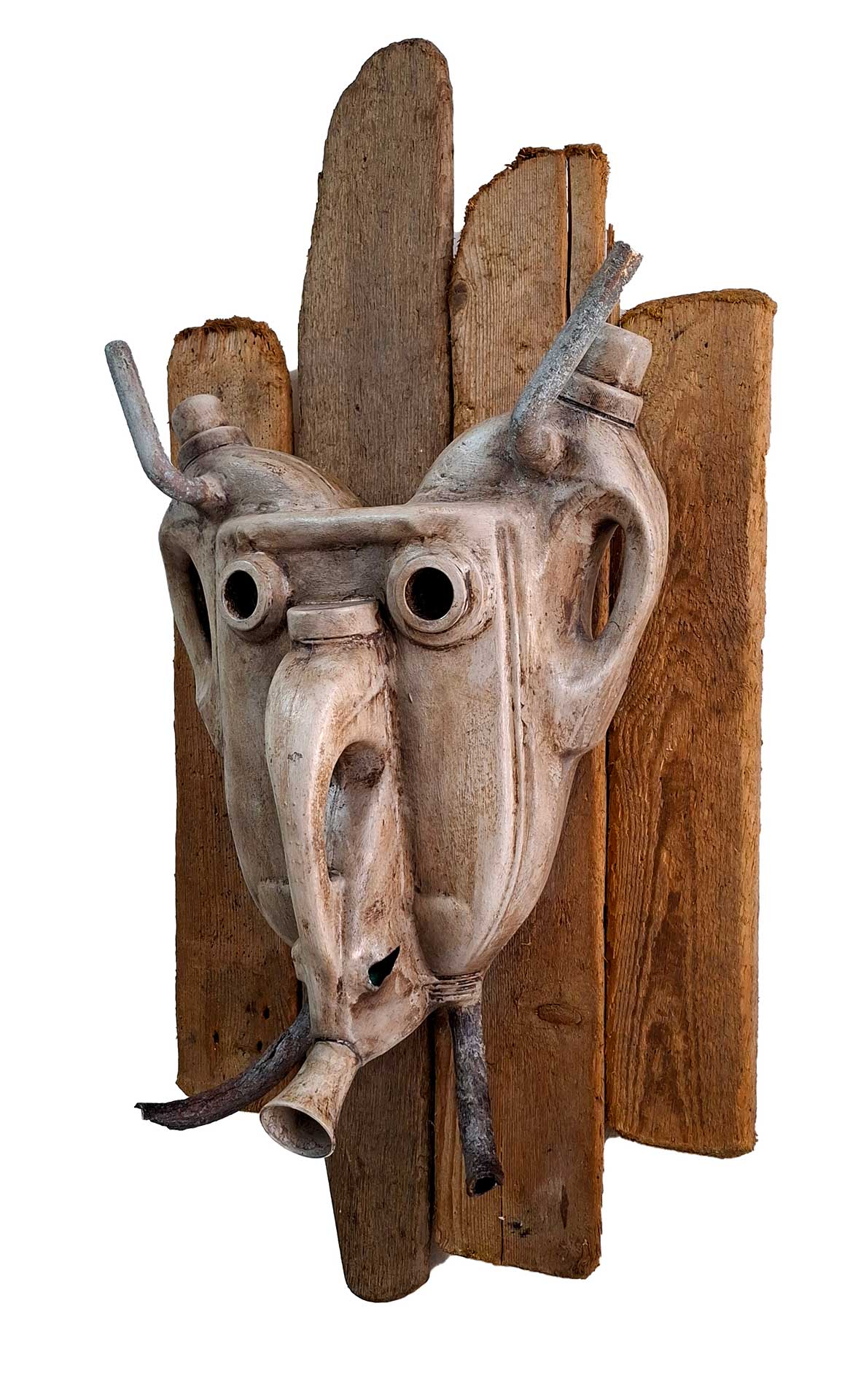
Beast of the Anthropocene is constructed from materials found along the shoreline: eroded plastic containers, fragments of corroded iron and wood transformed by its prolonged exposure to the sea.
When brought together, their original forms begin to disappear and a hybrid presence emerges, somewhere between a mask, a creature and a totem.
I was interested in working with what the materials already carried within them. The deformation of the plastic, the corrosion of the metal, and the cracks and wear of the wood are neither concealed nor corrected. They remain part of the work.
The sea and time had already begun a process of transformation before I intervened.
My role is to recognise those possibilities, select the fragments and bring them into relation until a new form emerges.
The resulting figure is not intended to represent a real creature. It operates as a metaphor: a presence born from objects that once belonged to everyday life and which return to the landscape as something else.
A beast constructed from the remnants of our own activity.

Plastic Hatchery

Artist: José R. Martín (Jrmartin), 2025
Series: Figures of the Shoreline
Medium: Hybrid sculpture / Installation
Materials: installation with recovered materials (oxidised bed frame, fishing nets, plastic bottles and containers, tyres, sand and marine debris)
Dimensions: 180 × 139 × 250 cm
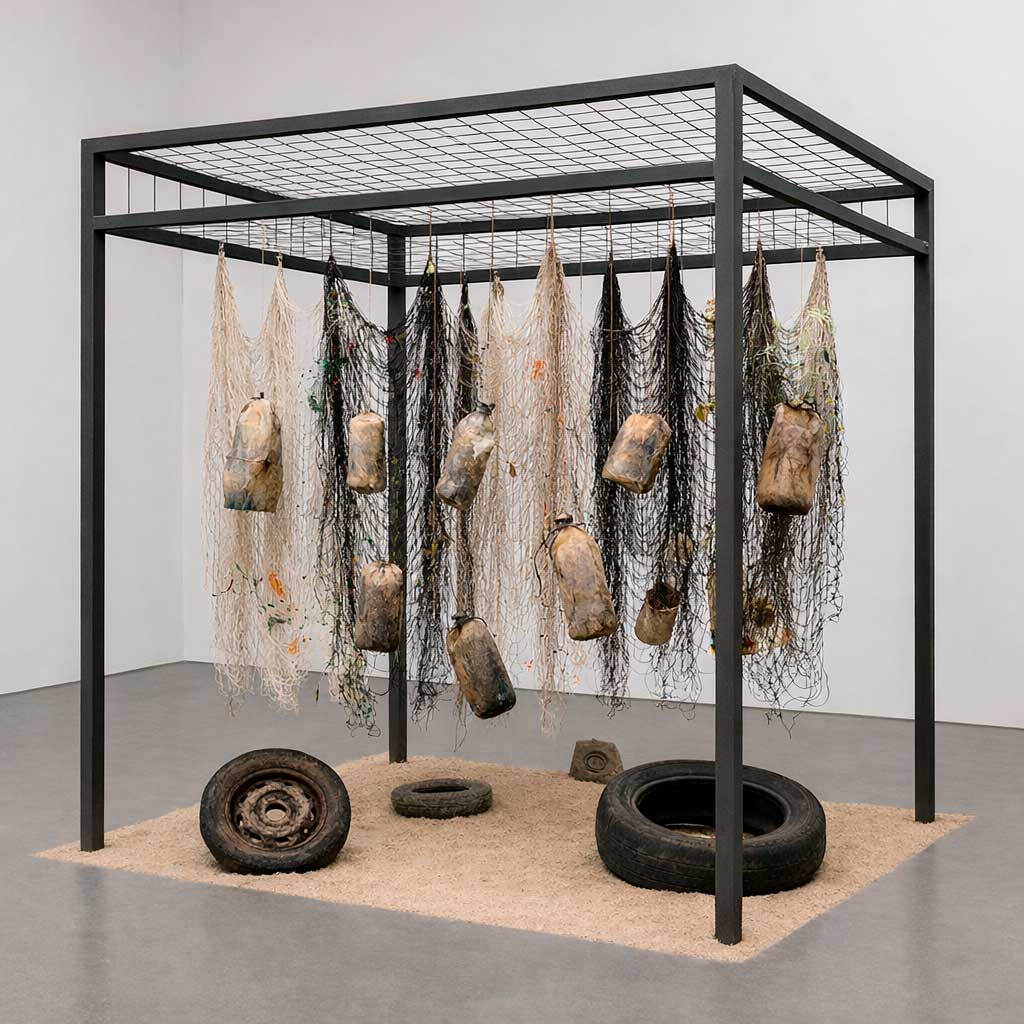
Plastic Hatchery is an installation constructed from materials recovered from the shoreline: fishing nets, plastic bottles and containers, tyres, marine debris and a metal framework that organises the composition.
The work draws visually on structures used for marine cultivation, but reverses their purpose.
Nothing here is being cultivated for food or life.
Waste hangs from the nets.
Bottles and containers remain trapped and suspended as though forming an artificial shoal. The image also connects with Drifting Nets and with lost or abandoned fishing nets that continue to move through the sea and can entangle turtles, cetaceans, seals, seabirds and other marine animals long after they have ceased to serve their original purpose.
In Plastic Hatchery, however, that logic is reversed: the nets appear to have captured the remnants of our own activity.
On the ground, sand, tyres and other materials extend this altered landscape.
I was interested in working with this double contradiction: a structure associated with the cultivation of life transformed into a hatchery for waste, and nets capable of trapping living creatures turned here into the support for a shoal of plastic.
I have not attempted to conceal the wear of the materials or neutralise their origins. Each element retains the marks of its former use and its time along the shoreline.
Plastic Hatchery therefore creates an unsettling image:
where there should be life, our own trace begins to appear.

Metallic Reef

Artist: José R. Martín (Jrmartin), 2025
Series: Figures of the Shoreline
Medium: Hybrid sculpture / Assemblage
Materials: driftwood, volcanic stones, sea-worn glass fragments, reused metal base —originally a domestic centrepiece—, recovered metal fragments and iron rods.
Dimensions: 56 × 50 × 62 cm
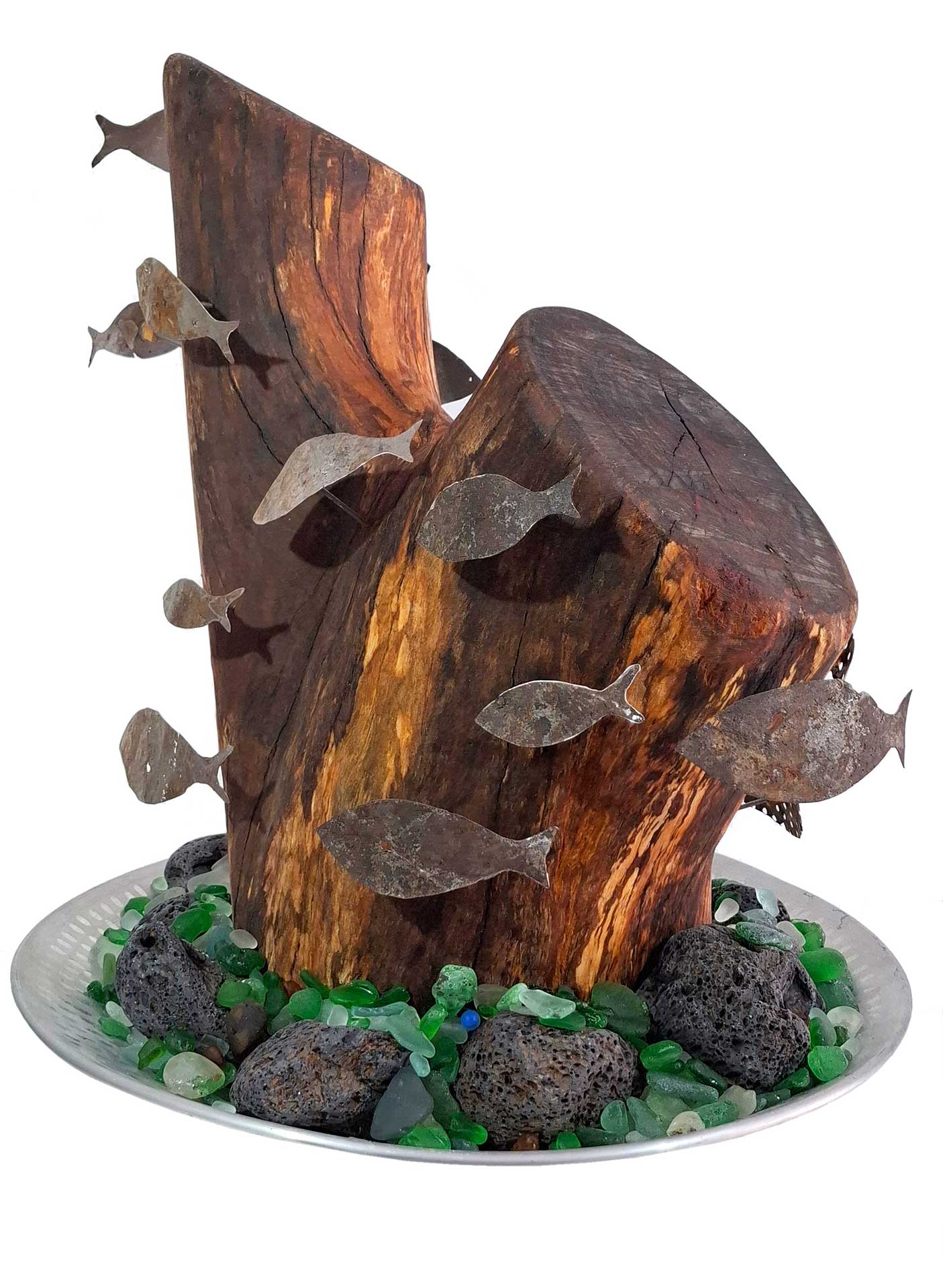
Metal Reef is constructed from materials found along the shoreline: an eroded piece of wood, stones, fragments of sea-worn glass and pieces of metal recovered from among the rocks. The metal base, originally a domestic object, acts as a container for the composition.
Unlike some of the other works in the series, my intervention here is more apparent.
The found metal fragments were cut and transformed into small fish that move across the surface of the wood. By bringing them together with the stones and eroded glass, I construct the image of a reef that belongs neither entirely to nature nor to the manufactured world.
It was precisely this mixture that interested me.
The wood, stones and fragments of glass have been altered by the shoreline. The fish, by contrast, emerge from discarded metal that I deliberately transform in order to give it the appearance of life once again.
The work does not attempt to reproduce a real reef. It constructs a possible one from what the coastline has brought together.
Natural matter, discarded objects and industrial remnants end up sharing the same space.
A small ecosystem constructed from what remained on the shore.

Habitat of Lost Species

Artist: José R. Martín (Jrmartin), 2025
Series: Figures of the Shoreline
Medium: Hybrid sculpture / Assemblage
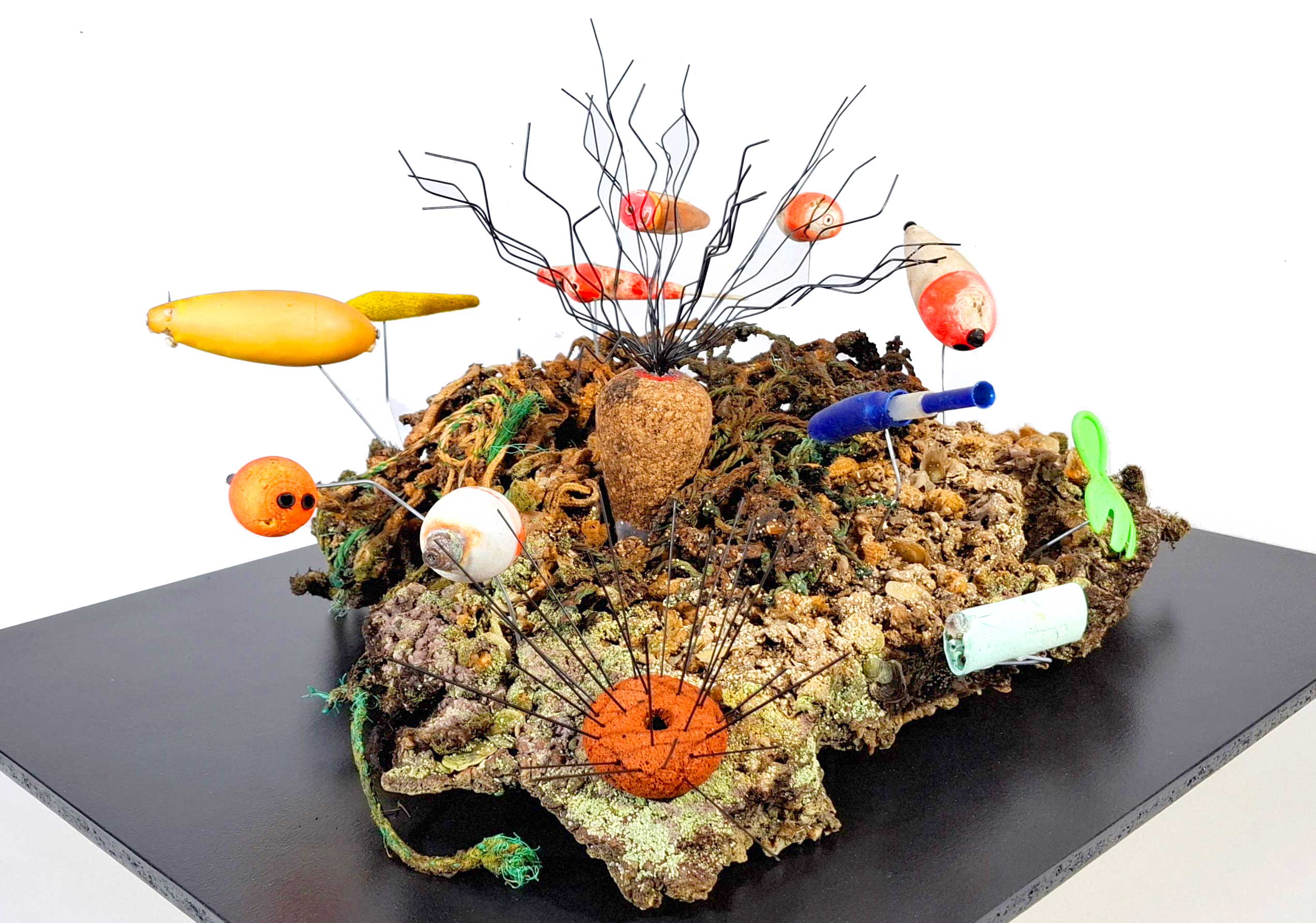
Materials: natural shoreline fragment, fishing floats, plastics, ropes, metals, sediments, dried seaweed, marine remnants and steel rods.
Dimensions: 60 × 50 × 28 cm
Habitat of Lost Species begins with a real fragment of shoreline onto which I have incorporated materials found along the coast: fishing floats, plastics, ropes, metals, sediments, dried seaweed and small marine remnants.
The work retains the irregularity and texture of the original fragment, but something else begins to grow across its surface.
The found objects are transformed into forms that recall fish, organisms, corals or small creatures that are difficult to identify. They are not intended to reproduce real species. Instead, they create an imaginary reef in which the natural and the artificial coexist until the boundary between them becomes uncertain.
It was this ambiguity that interested me.
Some elements come directly from the marine environment; others were manufactured by us and eventually became part of it. When brought together, they create new relationships and a form of possible life that exists only within the work.
The title also introduces an absence.
The ‘lost species’ are not literally represented. They are what is no longer visible, and whose place seems to have been occupied by these hybrid forms.
A possible reef constructed between what remains and what we have left behind.

Fragments That Breathe

Artist: José R. Martín (Jrmartin), 2025
Series: Figures of the Shoreline
Medium: Hybrid sculpture / Assemblage
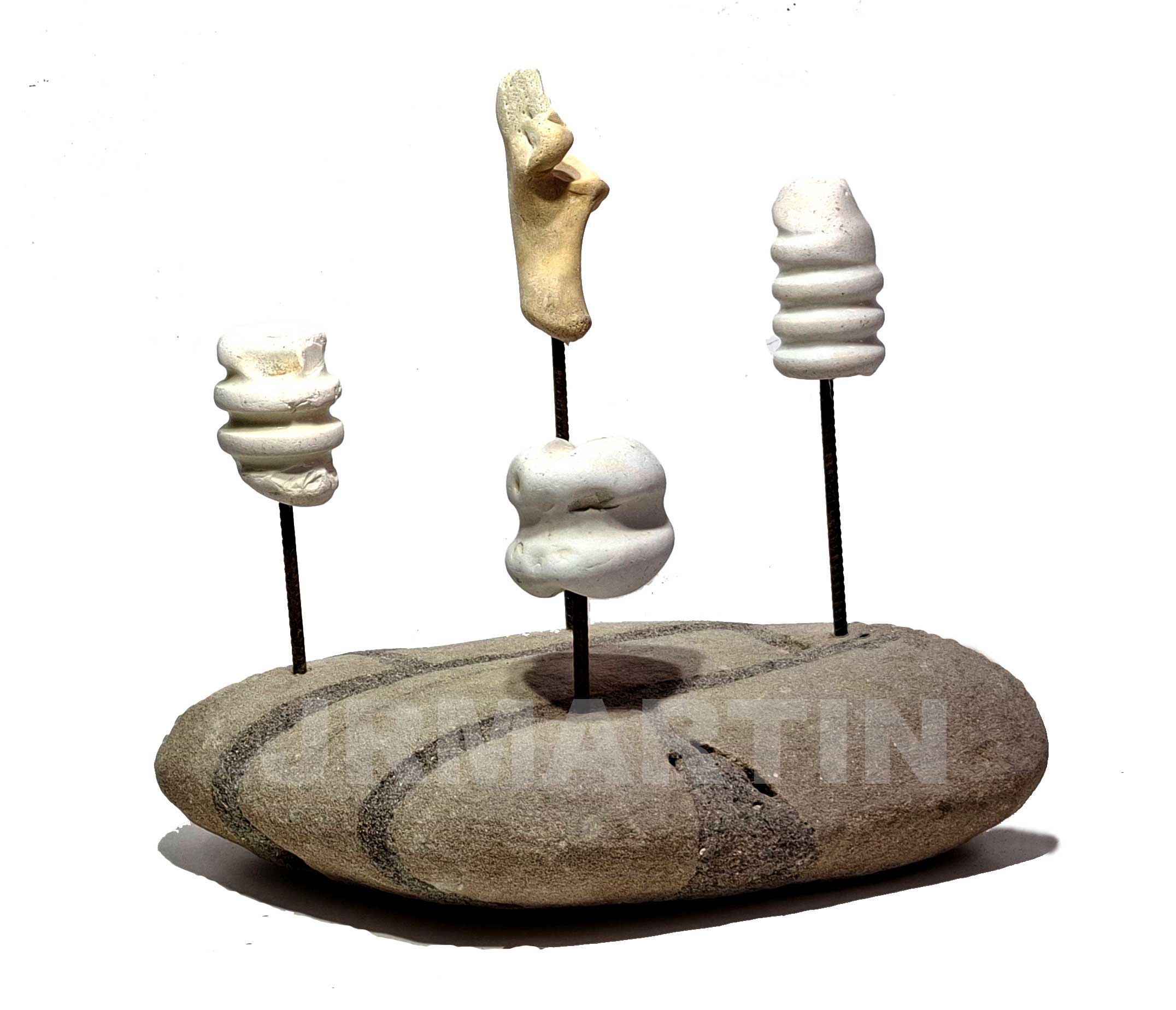
Materials: ceramic insulators, eroded bone, sandstone and metal rods
Dimensions: 40 × 27 × 37 cm
Fragments that Breathe grew out of the encounter between several objects collected along the shoreline: old ceramic insulators, a fragment of eroded bone and a piece of sandstone used as the base.
What first caught my attention were the shapes of the ceramic pieces.
Time, abrasion and prolonged exposure to the environment had softened their surfaces and altered their original appearance. Once separated from the industrial function for which they had been made, they began to resemble organic forms: small bodies, fragments of bone or volumes that appeared to have grown naturally.
This transformation reminded me of the biomorphic language of Henry Moore, particularly his use of rounded forms, cavities and volumes that move between the human body and the landscape.
I am not attempting to reproduce a work by Moore or to make a direct formal quotation. The reference arose from the association those found objects produced in my own way of looking at them.
By bringing the ceramics together with the bone and raising them above the stone, I wanted to retain that ambiguity between the industrial and the organic.
What were once technical components begin to resemble small organisms or remnants of an uncertain natural world.
Hence the title.
Inert fragments which, when we change the way we look at them, seem somehow still to breathe.

Guardian of the Shoreline

Artist: José R. Martín (Jrmartin), 2025
Series: Figures of the Shoreline
Medium: Hybrid sculpture / Assemblage
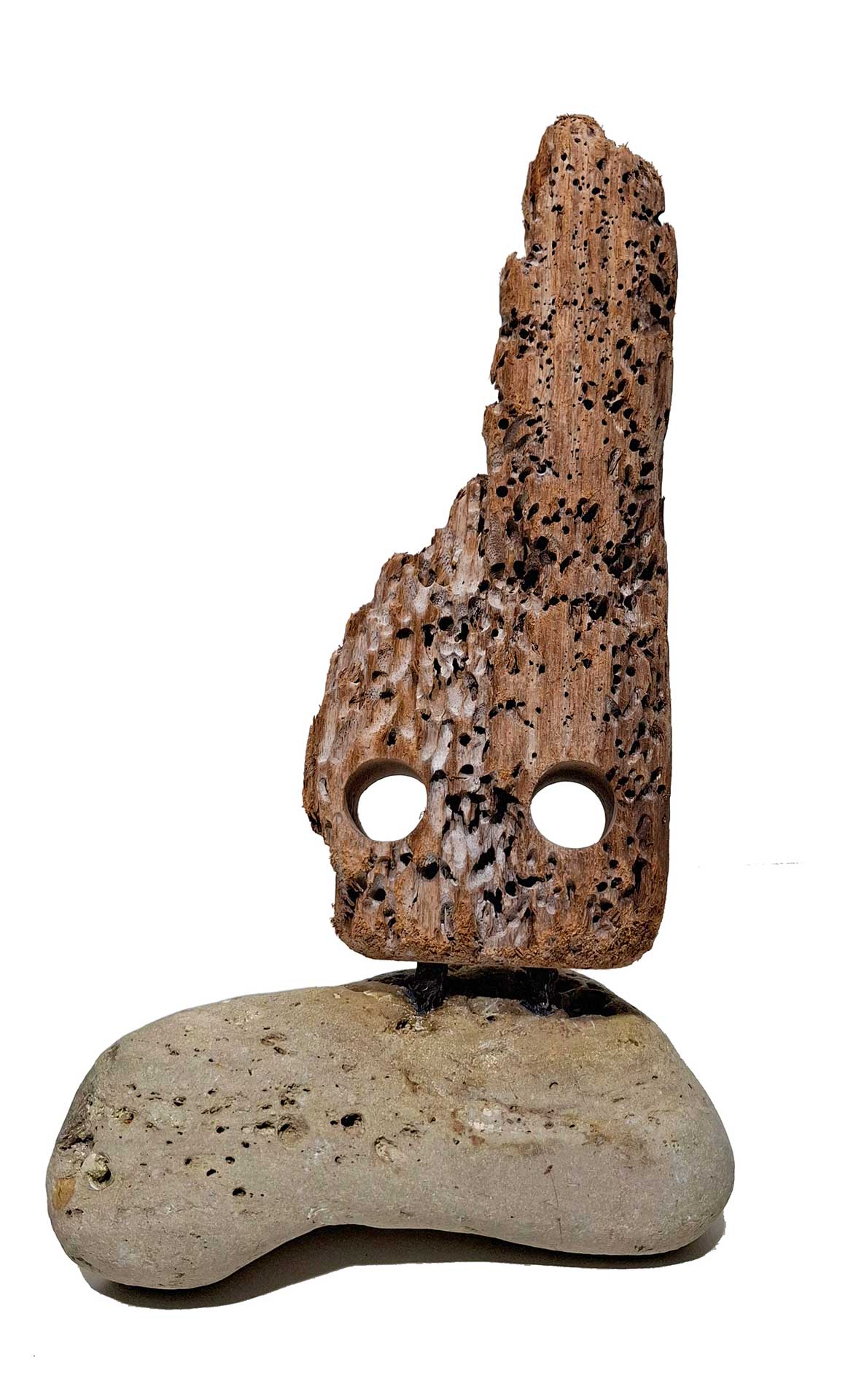
Materials: wood eroded by xylophagous organisms (termites, etc.), marine stone and metal rods
Dimensions: 20 × 20 × 38 cm
Guardian of the Shoreline grew out of a fragment of wood found on the coast, deeply transformed by wood-boring organisms, time and erosion.
When I found it, its shape already suggested a presence.
The holes, perforations and irregular silhouette of the wood seemed to reveal something resembling a face. I did not want to alter that transformation or impose a different figure upon it. My intervention consisted mainly of recognising it, isolating it and placing it upright on a stone also found along the shoreline.
The work therefore arises from a very simple association: seeing a figure where there had previously been only an abandoned fragment.
The wood retains all the marks of its deterioration. The openings and eroded areas are not concealed; they are precisely what gives the form its expression.
Raised above the stone, the found shape acquires an almost human presence, somewhere between a face, a mask and a small totem.
It does not represent any particular character.
It is simply one of those figures that the shoreline seems to create before we discover them.
In a sense, the sculpture was already waiting within the find.

Cyclops

Artist: José R. Martín (Jrmartin), 2025
Series: Figures of the Shoreline
Medium: Hybrid sculpture / Assemblage
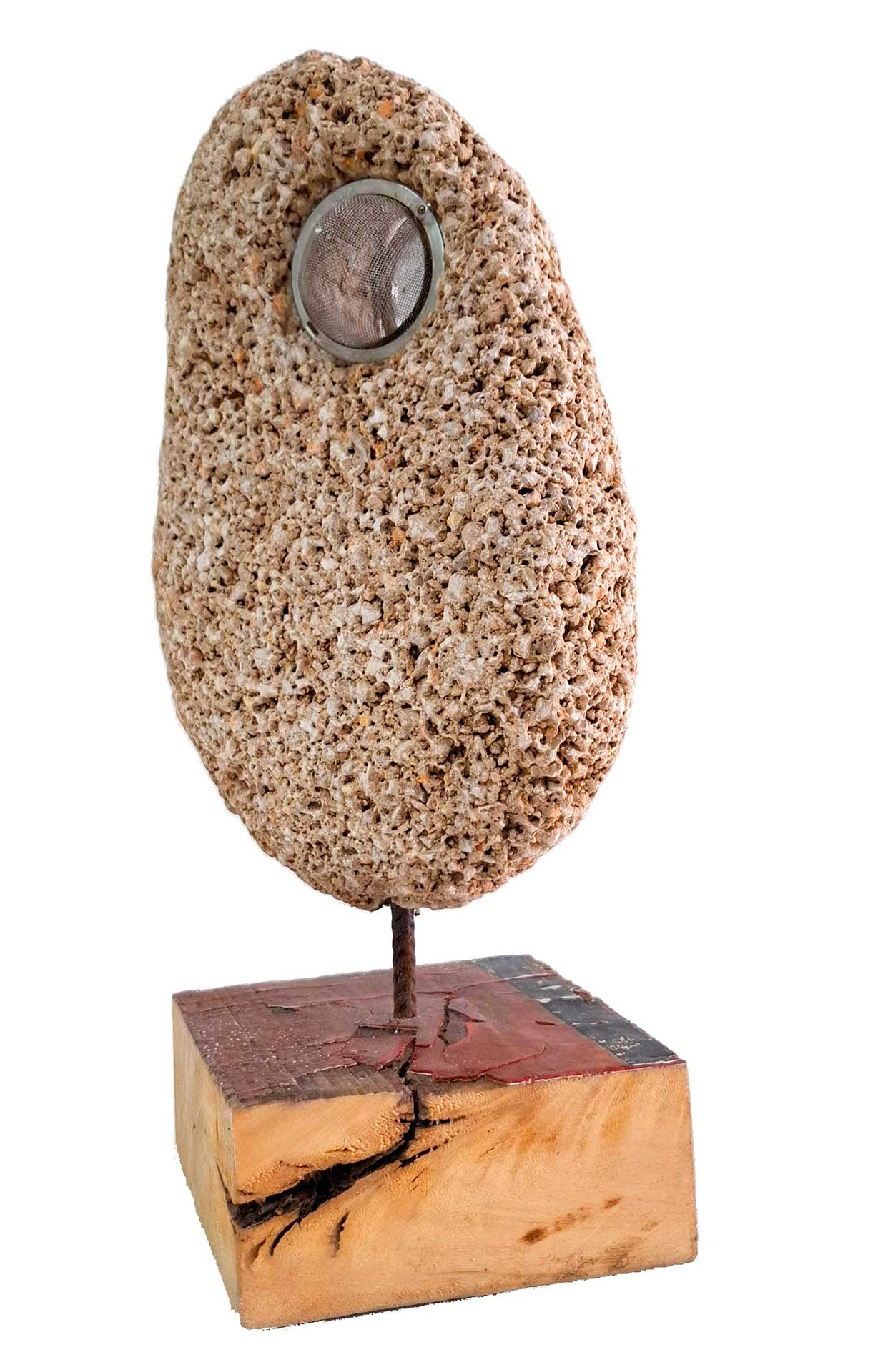
Materials: eroded porous stone, metal sieve, iron rod and reclaimed wooden base
Dimensions: 20 × 20 × 34 cm
Cyclops grew out of a porous stone found along the shoreline whose shape already suggested an upright, almost human presence.
By incorporating a small metal sieve, the manufactured object takes on another function: it ceases to be a utensil and becomes a single eye.
That minimal gesture completely changes the way the stone is perceived.
What was previously simply a natural fragment begins to resemble a figure, a mask or a small silent being.
The work is completed with an iron rod and a base made from reclaimed wood, while keeping the distinction between natural and manufactured materials clearly visible.
It was precisely this coexistence that interested me.
The stone has been shaped by natural processes; the sieve belongs to everyday human life. When brought together, they produce a form that existed in neither of them separately.
Hence the title.
A single added element is enough to make a stone begin to look back at us.

On Brancusi

Artist: José R. Martín (Jrmartin), 2025
Series: Figures of the Shoreline
Medium: Hybrid sculpture / Assemblage
Materials: sea-eroded wood, volcanic stone lightly carved and sanded, artificial stone base eroded by the shoreline, and joining elements.
Dimensions: 38 × 35.5 × 62 cm
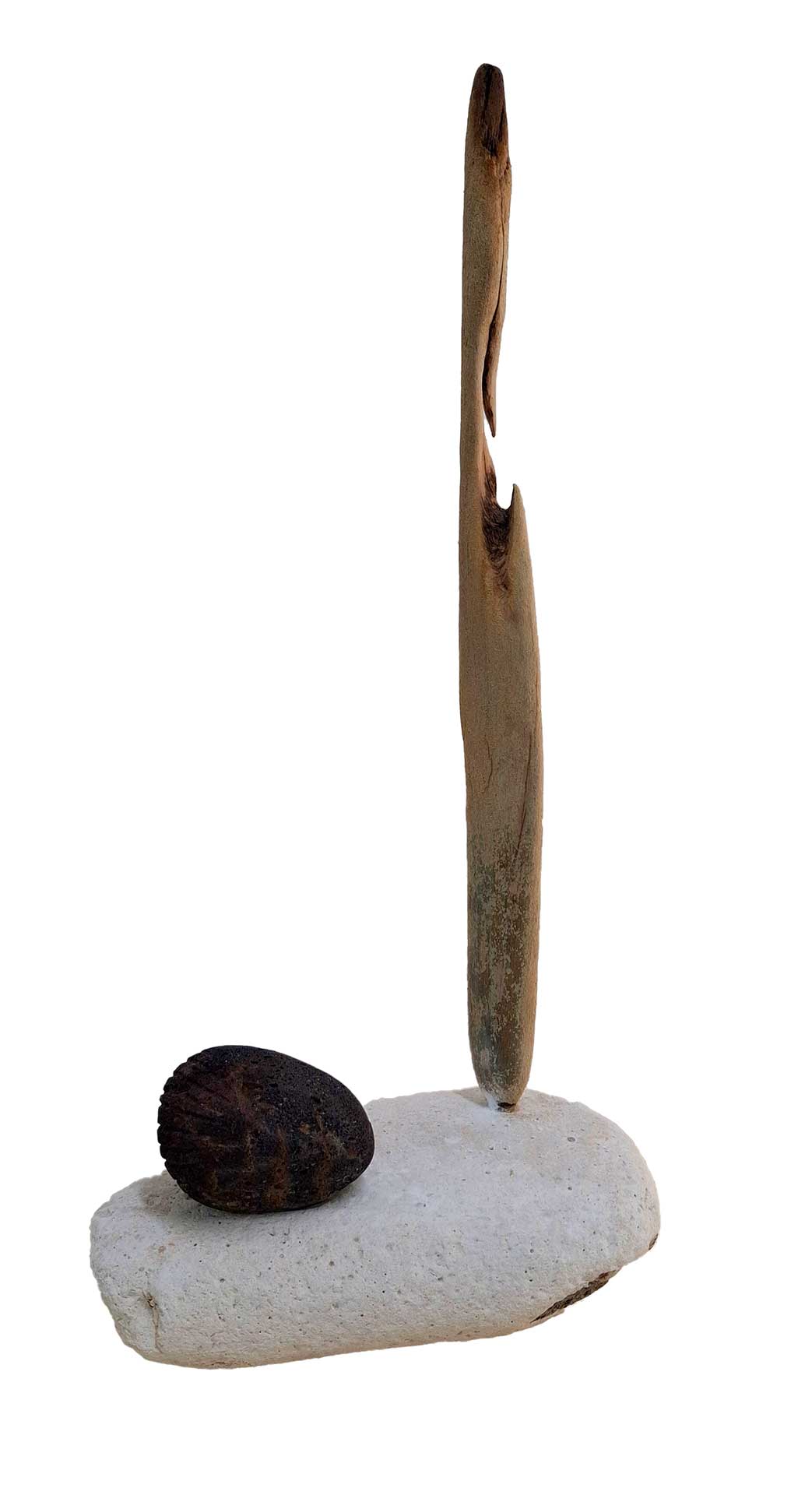
On Brancusi grew out of the encounter between several materials found along the shoreline and the association that arose while looking at them.
A small ovoid volcanic stone immediately reminded me of Constantin Brancusi’s Sleeping Muses. Beginning from that formal resonance, I lightly carved and sanded it in order to accentuate the suggestion of a face. Beside it, an elongated piece of wood, eroded by the sea, evoked through its verticality and slender form the upward tension of Bird in Space and, more distantly, the sense of elevation present in his Endless Column.
I was not trying to reproduce any of those works literally.
Rather, the piece emerges from a dialogue between found materials and the memory of certain essential forms in modern sculpture. My intervention is deliberately restrained: selecting, relating and arranging the elements, and introducing a slight act of carving on the stone in order to reinforce a possibility already latent in its form.
It was precisely this meeting between the found and the worked that interested me.
On the one hand, erosion and time had shaped the wood; on the other, the stone seemed to call for a minimal intervention in order to make visible its closeness to a sleeping head. The work therefore creates a dialogue between two different processes: the natural action of the shoreline and the human will to recognise and clarify a form.
Sometimes the landscape offers a form; at other times it asks only for a minimal gesture in order for us to see it.

The Seed of the Anthropocene

Artist: José R. Martín (Jrmartin), 2025
Series: Figures of the Shoreline
Medium: Hybrid sculpture / Assemblage
Materials: solidified mass —probably remnants of industrial or marine paint—, coastal sediment and particles of undetermined origin.
Dimensions: 24 × 24 × 28 cm
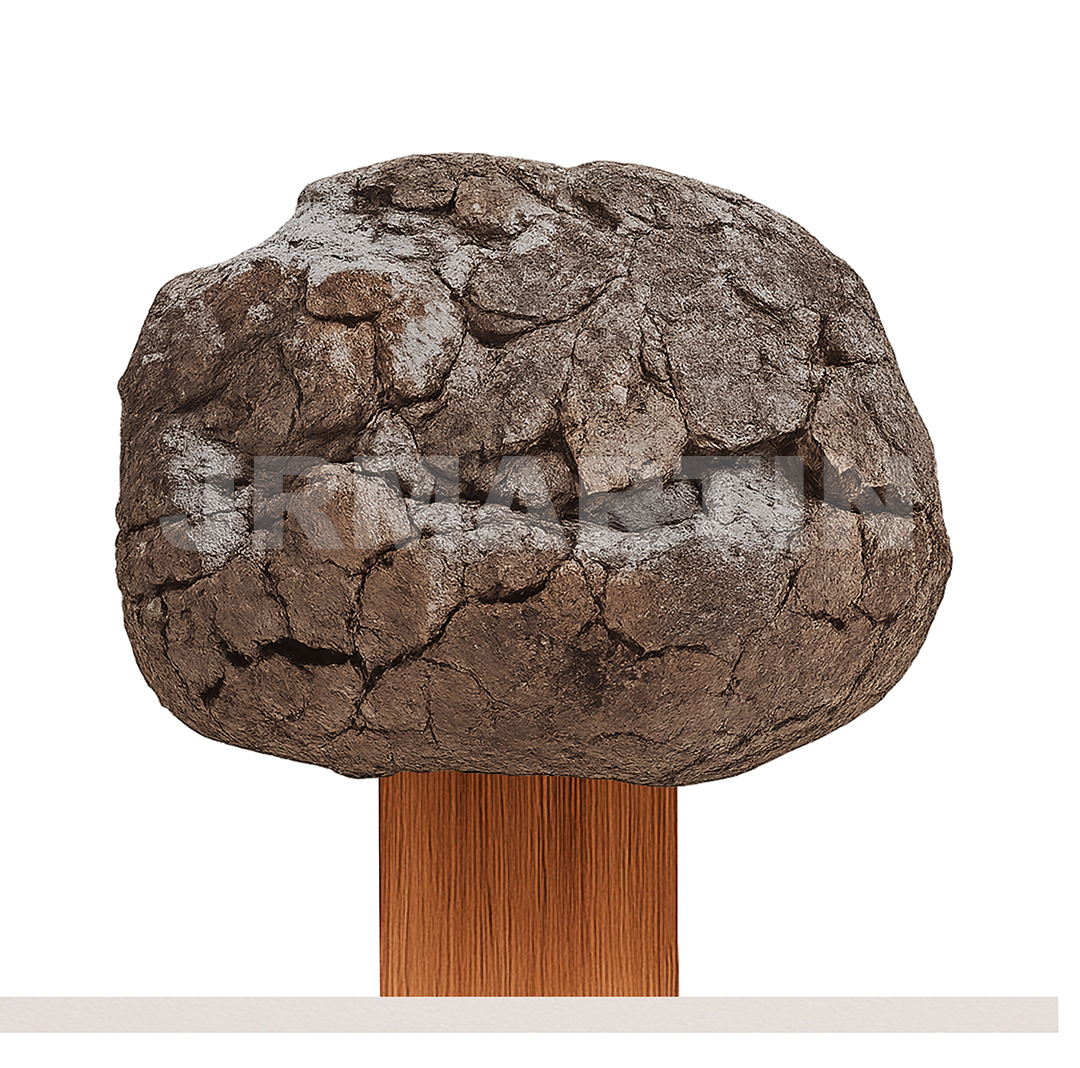
The Seed of the Anthropocene is, above all, a find.
I discovered it partially buried in the sand, inside the remains of a paint tin that had been almost completely destroyed by marine corrosion. Inside was this compact, solidified mass, probably formed from remnants of paint mixed with sediment and other materials.
The proximity of the cove to a shipyard made me wonder whether it might be some kind of marine or industrial paint or coating, although its composition has not been analysed.
Its cracked surface and almost mineral appearance reminded me of a stone, a fossil or a large seed.
I did not construct this form. I found it like this.
Its appearance bears a visual resemblance to the hybrid formations known as plastiglomerates, in which human-made materials become combined with natural sediments.
The title comes precisely from that contradiction: a seed usually suggests life and the future; this one appears to be formed from the remnants of our own activity.
Matter from the present with the appearance of a future fossil.

Shoal of Migrants

Artist: José R. Martín (Jrmartin), 2025
Series: Figures of the Shoreline
Medium: Hybrid sculpture / Assemblage
Materials: shoe soles found along the shoreline, driftwood and oxidised iron rods.
Dimensions: 130 × 19 × 77 cm
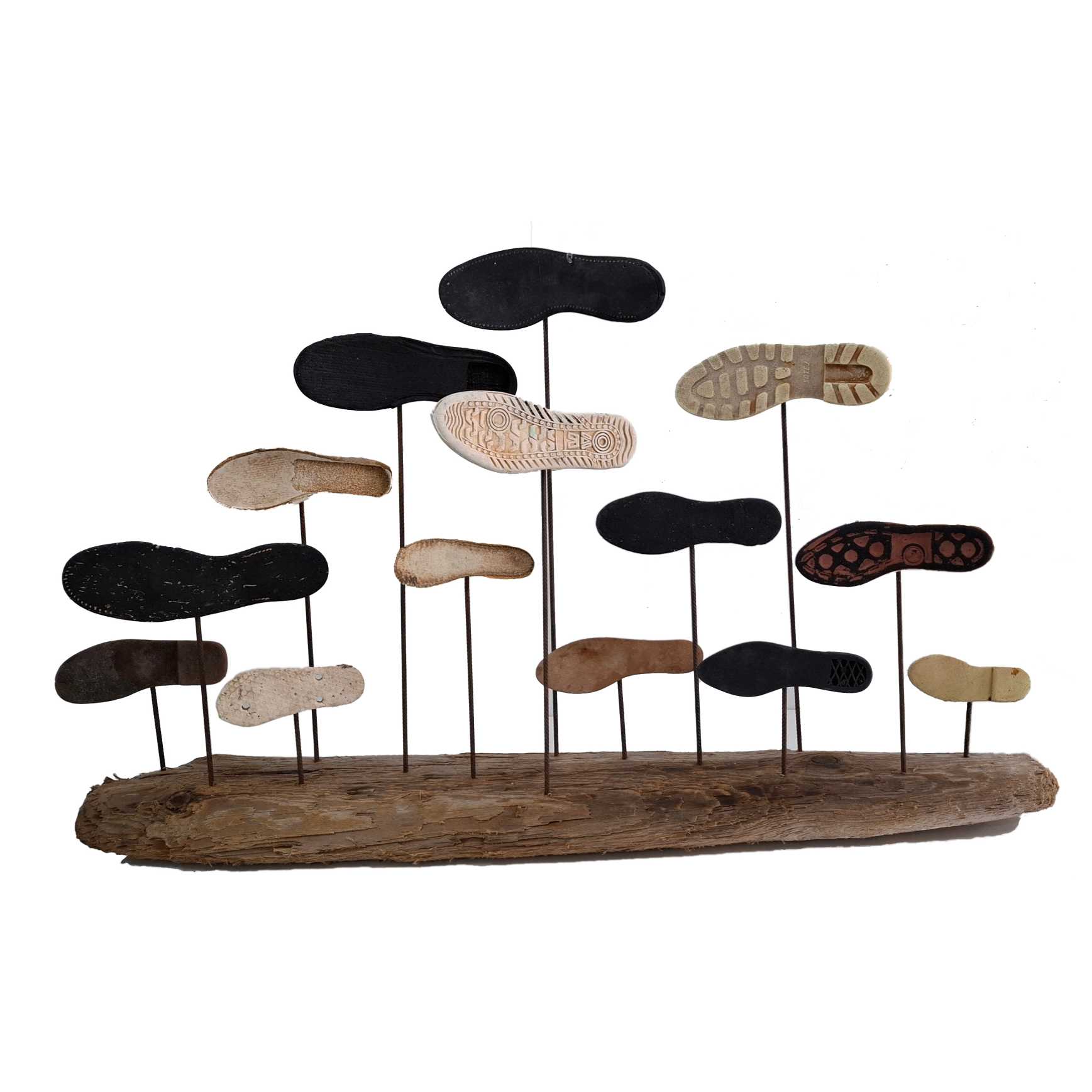
Shoal of Migrants is constructed from shoe soles found among the rocks along the shoreline, driftwood and oxidised iron rods.
Once separated from the shoes to which they had belonged, the shapes of the soles began to remind me of small silhouettes of fish.
I decided to bring them together above the piece of wood as a suspended shoal.
The transformation is simple, but it introduces another reading. A sole retains the idea of a footprint, a journey and movement; transformed into a fish, that same shape seems to continue its journey through another medium.
This is where the association with migration emerges.
I do not attribute any particular origin or story to these objects. They are found materials. Yet their presence on the shoreline and their condition as displaced remnants allow me to use them as a metaphor for movement, drift and the traces we leave along our journeys.
The work therefore brings together two images: the shoal of fish and human movement.
They do not walk, but they migrate.
Individual traces become a collective body, suspended for a moment above another material that has also travelled: a piece of wood returned by the sea.

Pelican

Artist: José R. Martín (Jrmartin), 2025
Series: Figures of the Shoreline
Technique: Digital photography / in-situ find
Medium: photographic print on canvas
Dimensions: 160 × 80 cm

Pelican grew out of a chance discovery on the shoreline itself.
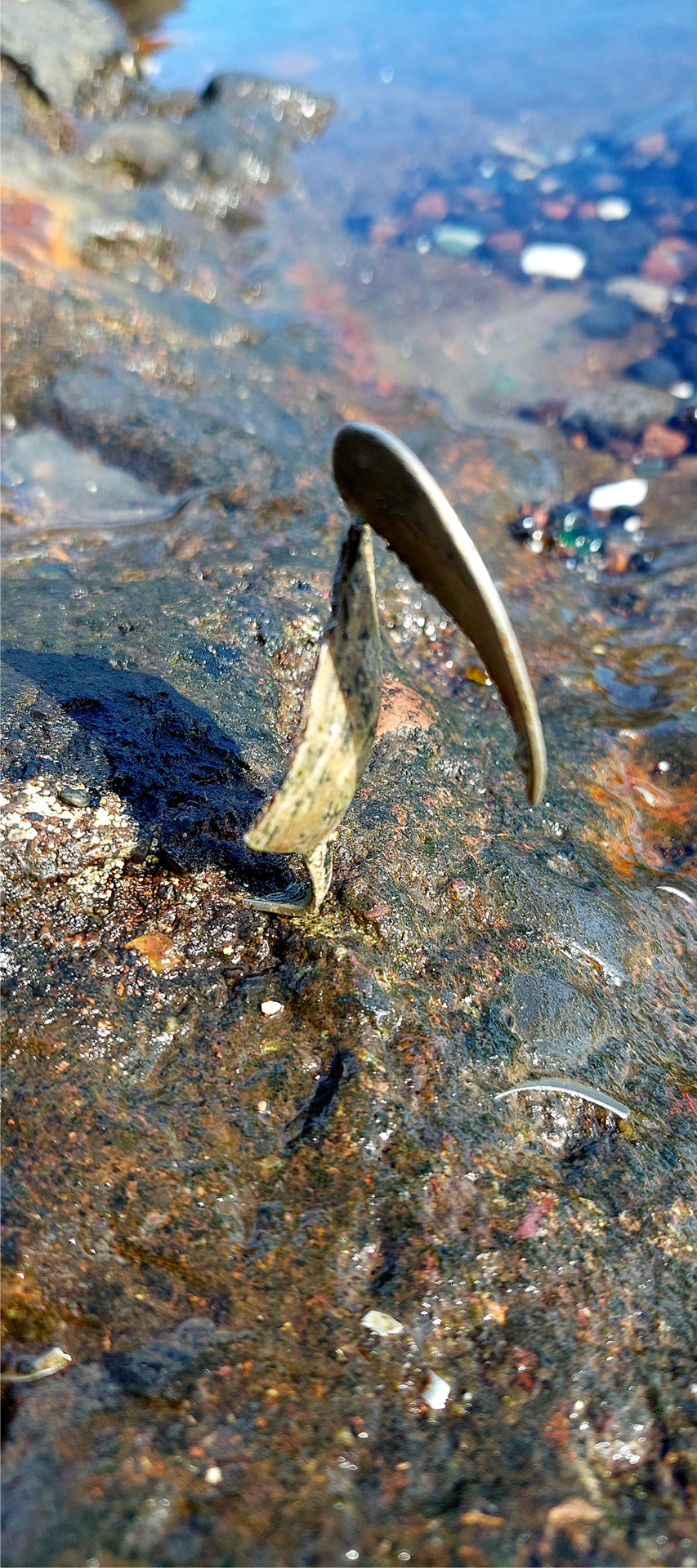
Among the remnants embedded in an eroded surface, I noticed a metal fragment —probably part of a utensil— whose shape and position immediately reminded me of the profile of a pelican.
I did not move or alter any of the elements.
The figure was already there.
My intervention consisted solely of recognising it and photographing it before the site changed again.
Corrosion, erosion and the accidental arrangement of the materials had created an image which, for a moment, seemed to cease being waste and acquire the presence of a living creature.
Within Figures of the Shoreline, this work represents the minimum degree of intervention: not assembling or transforming, but simply looking and discovering.
Sometimes the figure is not constructed. It simply appears.