
Figures of the Shoreline

Here, the assemblages and sculptures created from found debris evoke creatures, symbols and metaphors. Works such as Beast of the Anthropocene transform waste into totemic forms that directly confront the viewer with the new “nature” we are creating.

When the shoreline returns what we have discarded, sculpture becomes evidence.

Figures of the Shoreline presents sculptures constructed from remains collected along the coasts of Gran Canaria. They are domestic objects and industrial materials returned by the sea after a process of erosion that does not erase their origin. The series does not attempt to render them beautiful. It presents them as they are: material symptoms of a problem that has already become part of the landscape.

These works function as hybrid bodies, akin to creatures, totems or fossil fragments. Their appearance does not seek to generate myth, but to expose a contradiction: contamination has reached a point at which waste can be mistaken for a possible form of life. The artist neither corrects nor refines. He preserves the trace of damage because that trace is the message.

The project operates as a critical inventory of the present. Each plastic fragment, each oxidised metal, each piece of eroded wood demonstrates how the everyday ultimately becomes environmental ruin. These materials are not neutral. They are direct evidence of a crisis that continues to grow even as it becomes normalised. Here, sculpture serves to interrupt that normalisation.

The shoreline emerges as an involuntary archive, collecting the consequences of our habits. The organic and the industrial intermingle until they become inseparable, producing forms that unsettle through their starkness. They do not seek to console. They seek to reveal what we would rather not see.

Figures of the Shoreline does not claim to offer solutions. Its function is to activate a more conscious gaze, to remind us that every recovered fragment is part of a chain of human decisions, and that the landscape already speaks through the remains we leave behind. In this case, art does not soften reality. It makes it impossible to ignore.

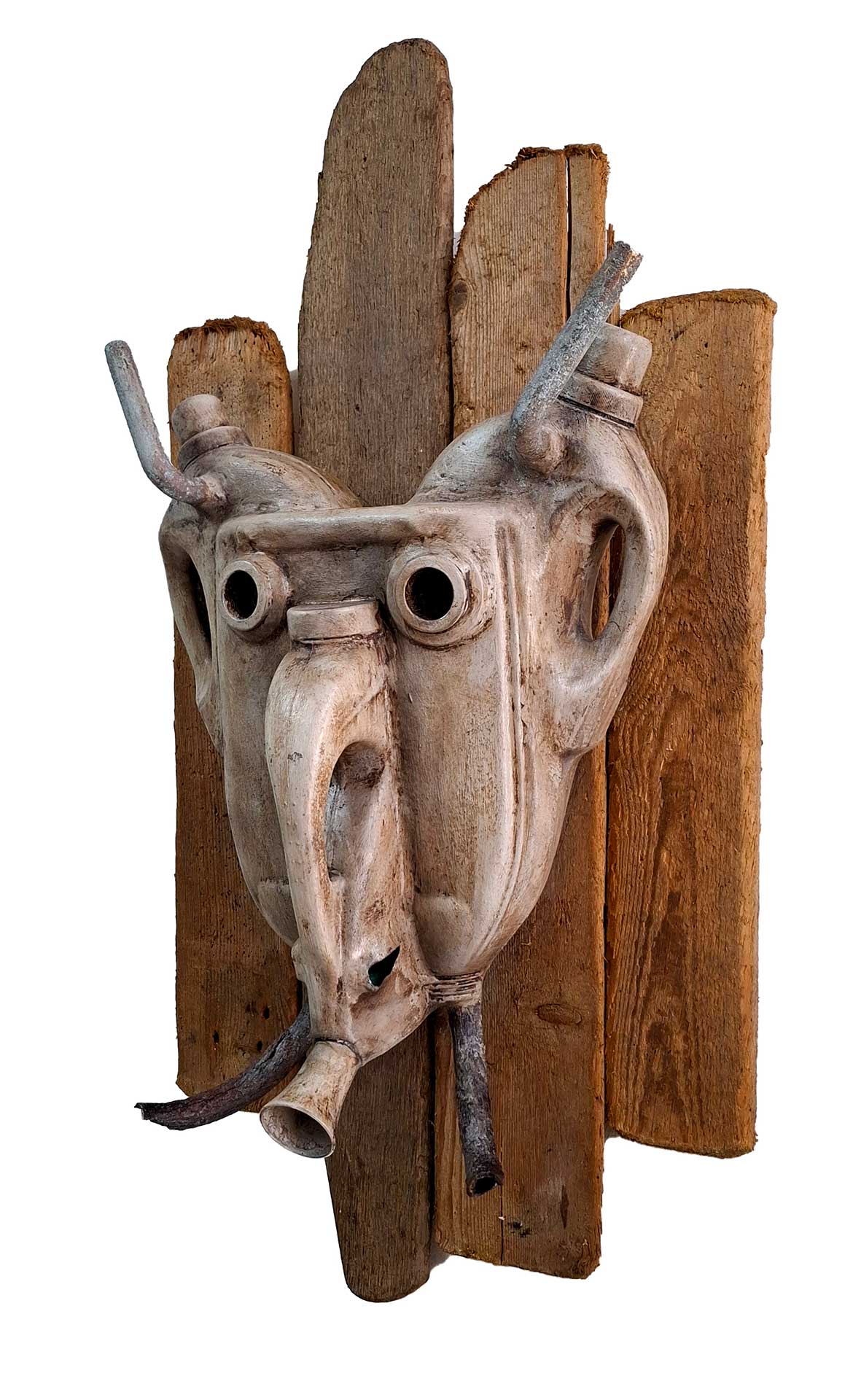
Beast of the Anthropocene

Artist: José R. Martín (Jrmartin), 2025
Series: Figures of the Shoreline
Medium: Hybrid sculpture / Assemblage
Materials: Assemblage of eroded plastic containers, oxidised iron and driftwood
Dimensions: 92 × 47 × 24 cm
The work presents a hybrid figure constructed from objects collected along the shoreline: domestic plastics, corroded metal fragments and wood eroded by prolonged exposure to the sea. Assembled without concealing their wear or origin, these materials form a shape that recalls an animal mask or a primitive totem, positioned in an ambiguous territory between the recognisable and the monstrous.

Time and environment have acted as co-authors of the piece. Salinity, oxidation and marine friction have softened, distorted and transformed the objects, erasing their original function and giving them an almost organic appearance. The sculpture thus appears as an anticipated fossil, a relic from a future in which the remains of the present have been absorbed by nature and reinterpreted as cultural vestiges.

Far from idealising the materials, the work emphasises their rawness. Each crack, stain and deformation speaks of abandonment, accumulation and a persistent human presence even in its absence. The figure does not represent a mythological being, but rather a direct metaphor for the ecological footprint: an impossible creature born of waste, returned by the sea as material testimony of the Anthropocene. Ultimately, it is an unsettling portrait of our relationship with the environment, where what comes back is not life, but the transformed reflection of our own impact.

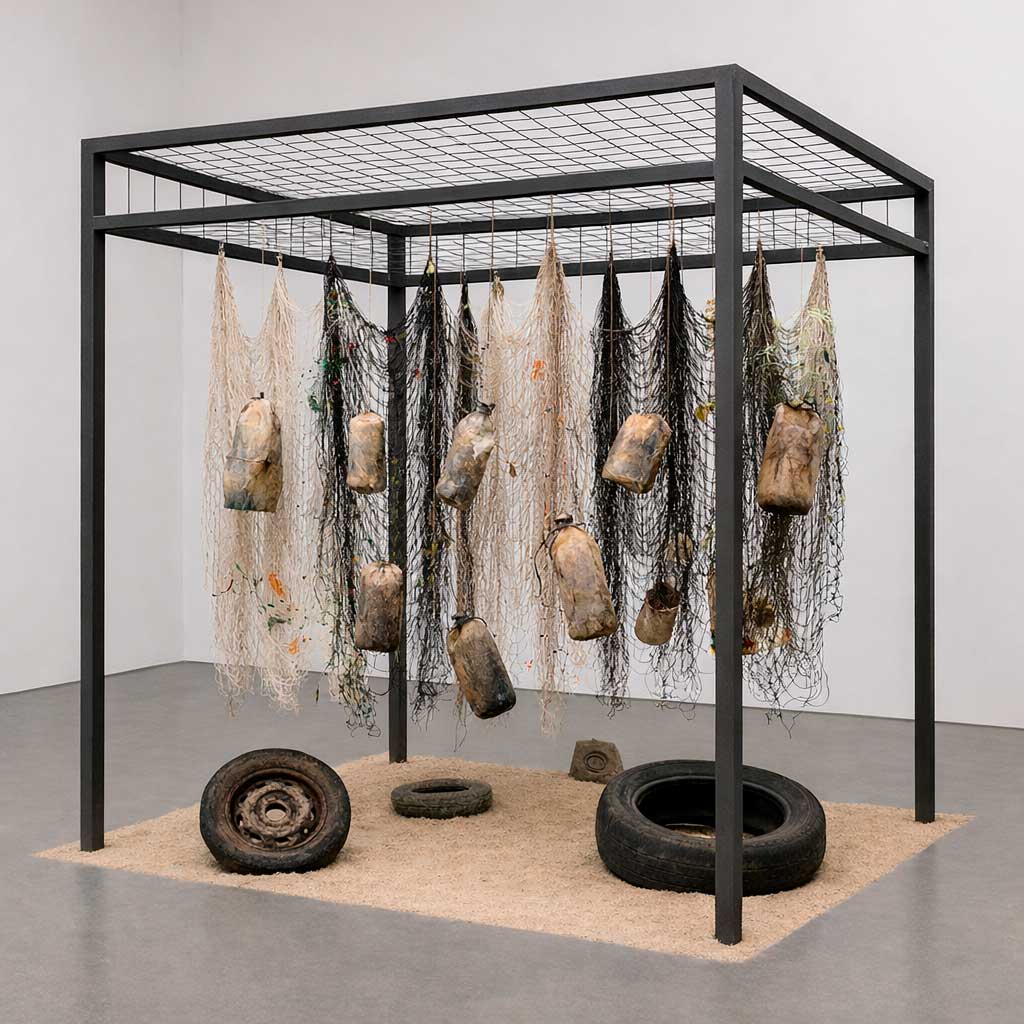
Plastic Hatchery

Artist: José R. Martín (Jrmartin), 2025
Series: Figures of the Shoreline
Medium: Hybrid sculpture / Installation
Materials: Installation with recovered materials (oxidised bed frame, fishing nets, plastic bottles and containers, tyres, sand and marine debris)
Dimensions: 180 × 139 × 250 cm
Plastic Hatchery is an installation constructed from found and reused materials, primarily abandoned fishing nets and an oxidised metal structure functioning as a suspended support. Inspired by mussel farming systems, the work proposes an unsettling inversion: instead of generating food or marine life, the sea appears to produce and return waste. From the nets hang bottles and plastic containers collected along the coast, suspended like trapped bodies or ghost species — remnants of human activity no longer present, yet still operative.

The sand-covered floor recreates an artificial seabed where eroded tyres, stones and anonymous objects returned by the tide come to rest. These elements are not simulations, but real fragments of the shoreline, integrated into the installation’s landscape.

The work refers to the concept of ghost nets — abandoned fishing gear that continues to trap organisms for years — and extends it to a broader symbolic scale: that of the Anthropocene, understood as an era in which even obsolete human infrastructures become persistent traps.

Plastic Hatchery proposes an inverted ecosystem in which waste replaces life and natural cycles are disrupted. The final question remains open, and unsettling: what if this were, ultimately, the only thing the sea could return?

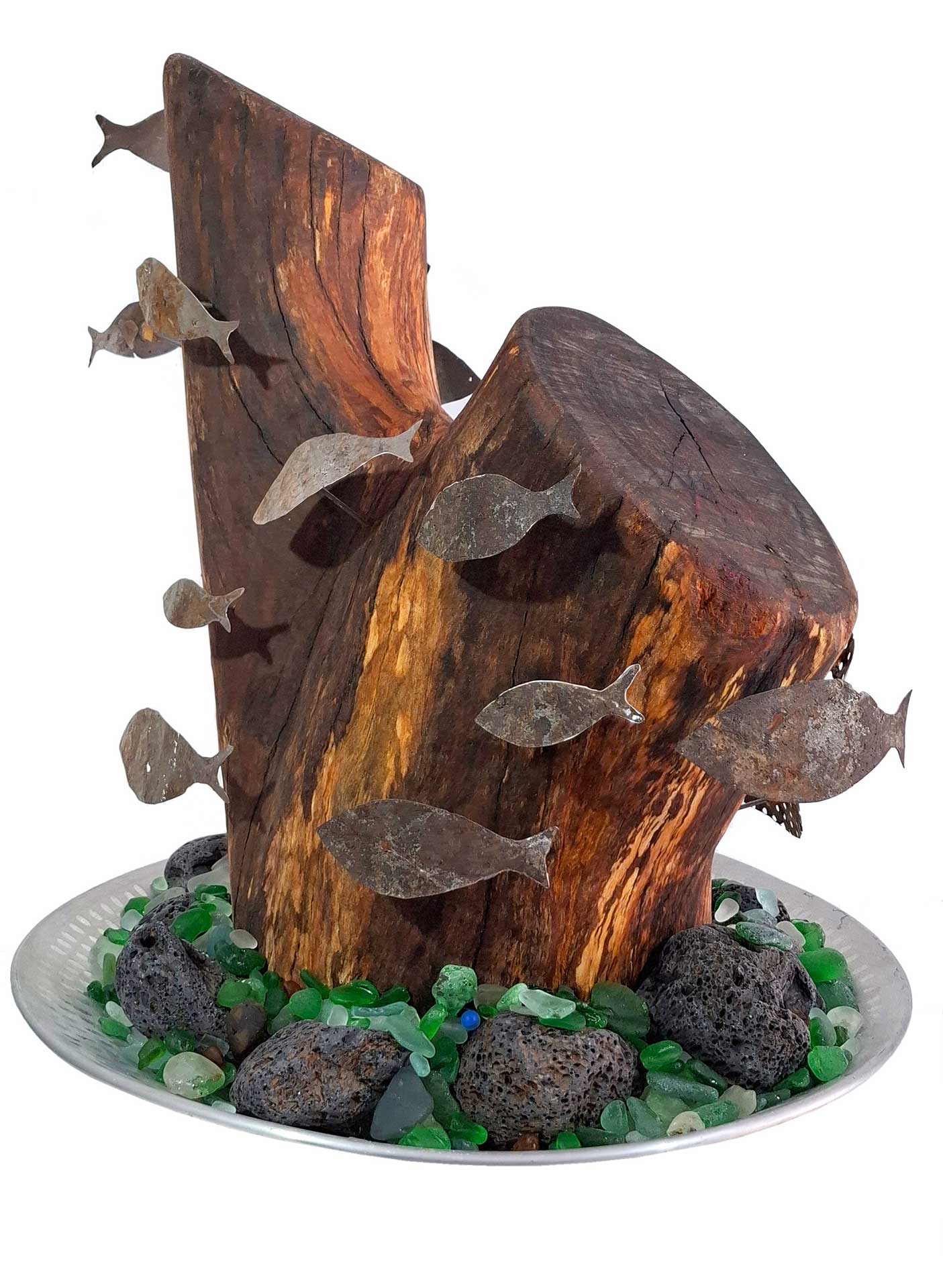
Metallic Reef

Artist: José R. Martín (Jrmartin), 2025
Series: Figures of the Shoreline
Medium: Hybrid sculpture / Assemblage
Materials: Driftwood, recycled metal sheets, volcanic rocks, eroded glass, aluminium and iron rods
Dimensions: 56 × 50 × 62 cm
The work emerges from dispersed fragments found along the shoreline — corroded metal sheets, stranded wood, eroded glass — which the artist recomposes into a new sculptural ecosystem. Around a central trunk, metallic fish orbit as if guarding a submerged totem, a remnant of civilisation reshaped by the tide. What was once waste becomes organism; what the sea eroded is reborn as an imagined habitat.

Metallic Reef embodies the poetics of the Anthropocene: beauty born from ruin, a reconciliation between the natural and the manufactured. Beneath its apparent stillness pulses a circular, almost ritual movement that recalls the relentless cycle of material transformation. The work does not represent a marine landscape; it reactivates it, returning to the viewer an essential question: where does the human object end and life begin?

Reef of Lost Species

Artist: José R. Martín (Jrmartin), 2025
Series: Figures of the Shoreline
Medium: Hybrid sculpture / Assemblage
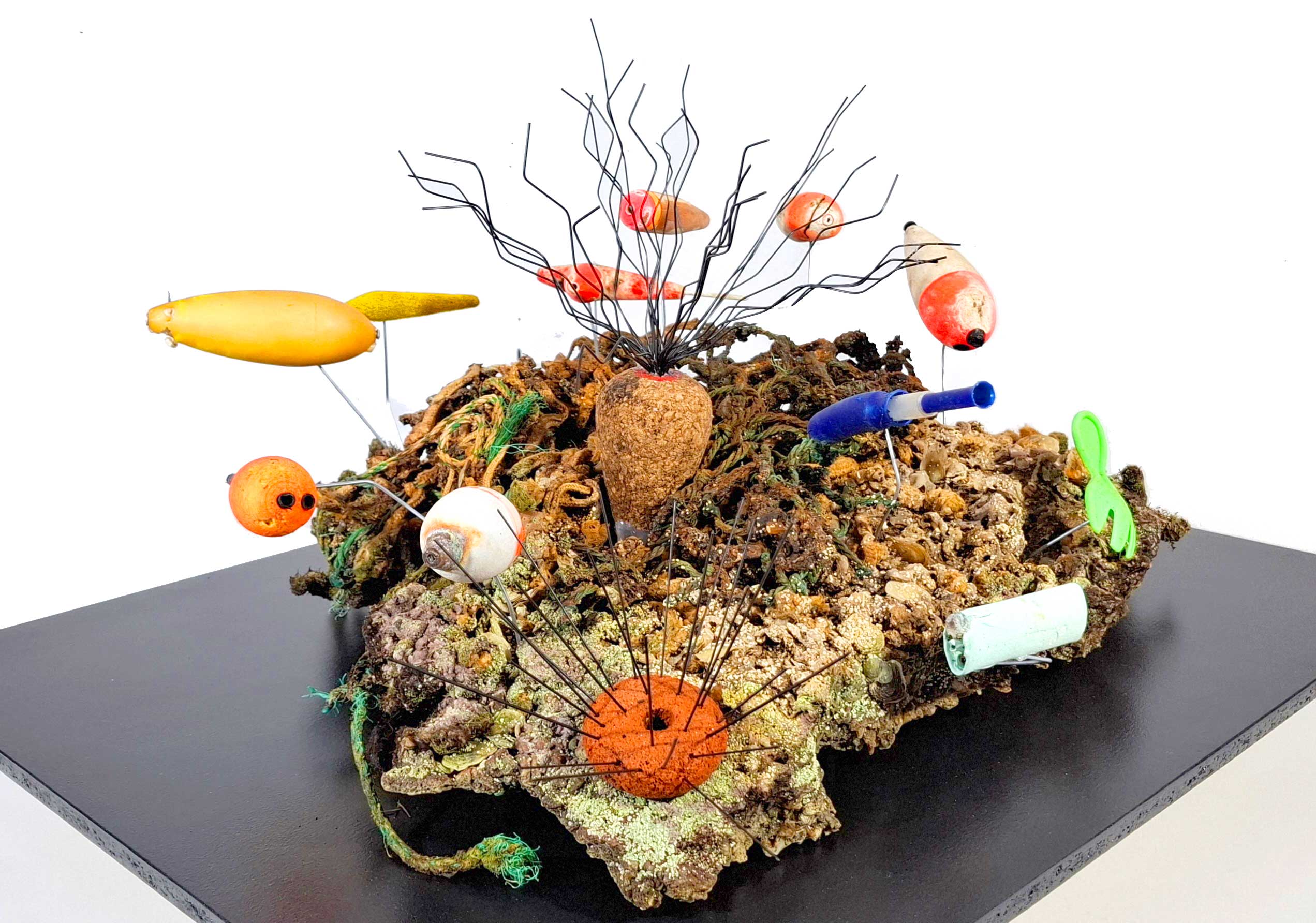
Materials: Natural coastal fragment intervened with materials recovered from the shoreline (fishing buoys, plastics, ropes, metals, sediments, dried algae, shells and steel rods)
Dimensions: 60 × 50 × 28 cm
The work begins with a real coastal fragment, understood as an active fossil within an ongoing process of accumulation. Across its surface adhere residues carried by the sea — plastics, buoys, metals, fibres and organic remains — forming a hybrid structure akin to a living colony. The artistic intervention reorganises these elements without concealing their origin, emphasising their formal and symbolic transformation.

The whole assumes the appearance of an imagined reef inhabited by artificial species, where former technological objects acquire biological traits. The piece does not depict a speculative future, but a condition already present along many shorelines: landscapes in which the natural and the discarded coexist, and where waste does not disappear, but becomes integrated into a new ecosystem.

Fragments That Breathe

Artist: José R. Martín (Jrmartin), 2025
Series: Figures of the Shoreline
Medium: Hybrid sculpture / Assemblage
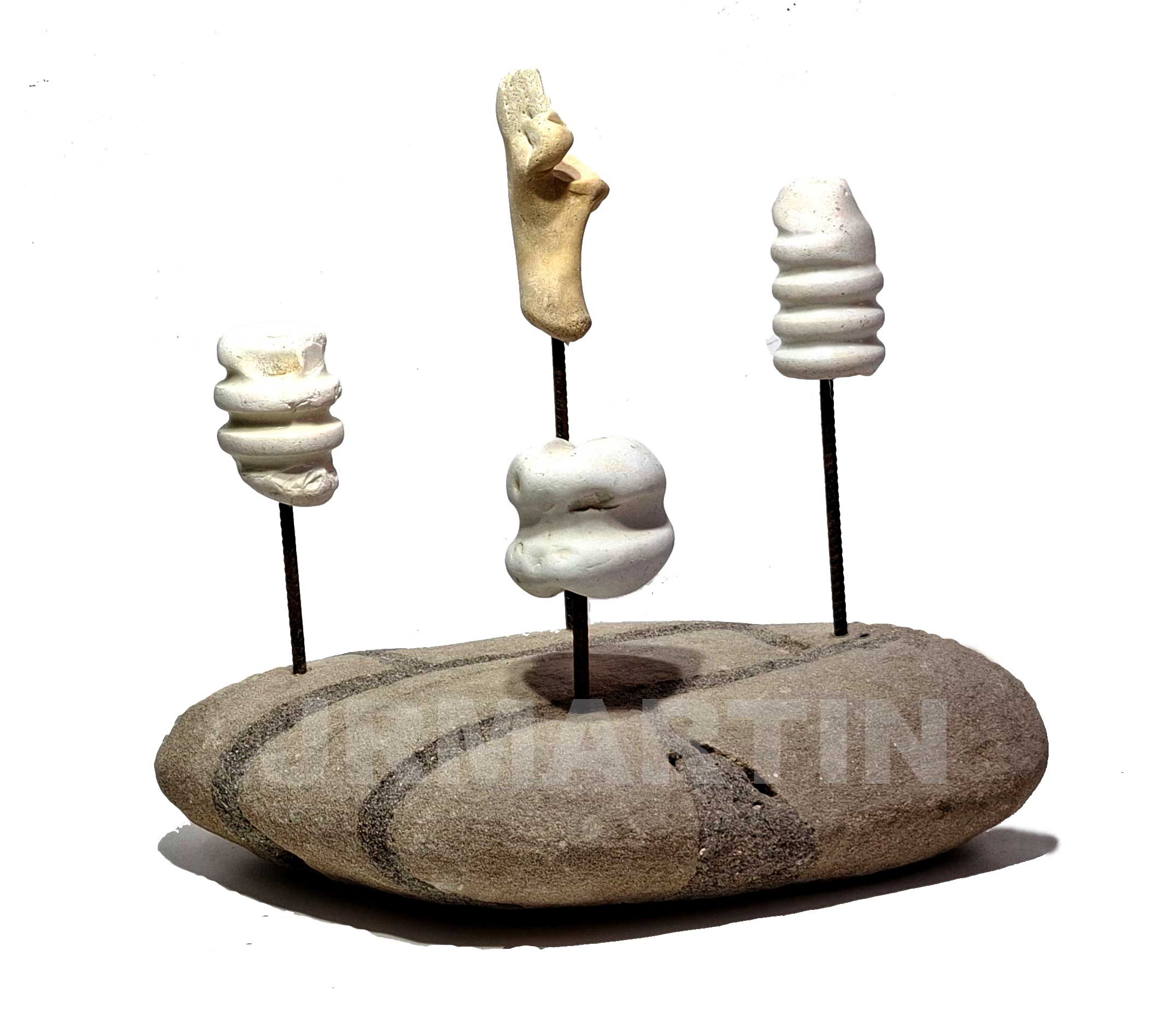
Materials: Ceramic insulators, eroded bone, sandstone and metal rods
Dimensions: 40 × 27 × 37 cm
Three ceramic forms emerge from a sandstone base, accompanied by a suspended bone fragment that functions as the organic axis of the composition. Once industrial electrical insulators, these elements are transformed here into sculptural forms charged with resonance.

The dialogue between the eroded bone and the curved ceramic shapes suggests a fusion between the natural and the manufactured, between functional vestige and imagined archaeology. The composition recalls the biomorphic language of Henry Moore, relocated to a coastal landscape where the technical has mineralised and the biological has fossilised.

This sculpture operates as a hybrid time capsule, in which matter seems to preserve the breath of what was once alive — or once electrically charged.

Groot

Artist: José R. Martín (Jrmartin), 2025
Series: Figures of the Shoreline
Medium: Hybrid sculpture / Assemblage
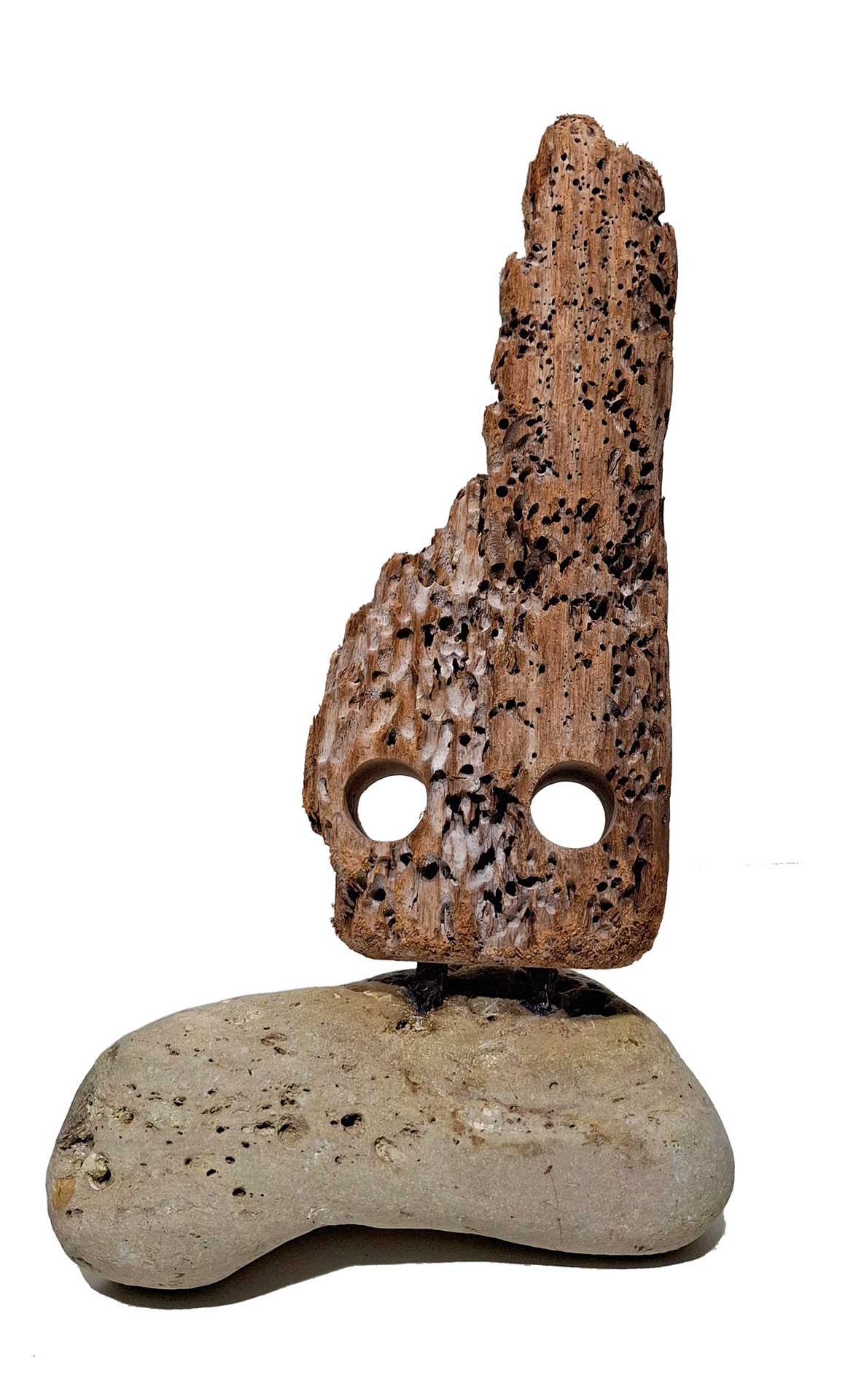
Materials: Wood eroded by xylophagous organisms (termites, etc.), marine stone and metal rods
Dimensions: 20 × 20 × 38 cm
Groot transforms a fragment of driftwood — eaten away by termites or other wood-boring organisms — into a symbol of organic resilience. The cavities that were once wounds now read as open eyes, charged with expression.

The verticality of the form and its grounding upon an eroded stone reinforce the impression of a totem or ritual figure, yet without artifice: it is nature itself that has shaped it.

This piece sits at the heart of the Figures of the Shoreline series, where found materials become bodies, faces and ambiguous entities. Its form recalls archaic sculptures or ancestral guardians, yet articulated through a contemporary language that speaks of ecological transformation.

It is a face of the Anthropocene: vulnerable, eroded, yet still standing.

Cyclops

Artist: José R. Martín (Jrmartin), 2025
Series: Figures of the Shoreline
Medium: Hybrid sculpture / Assemblage
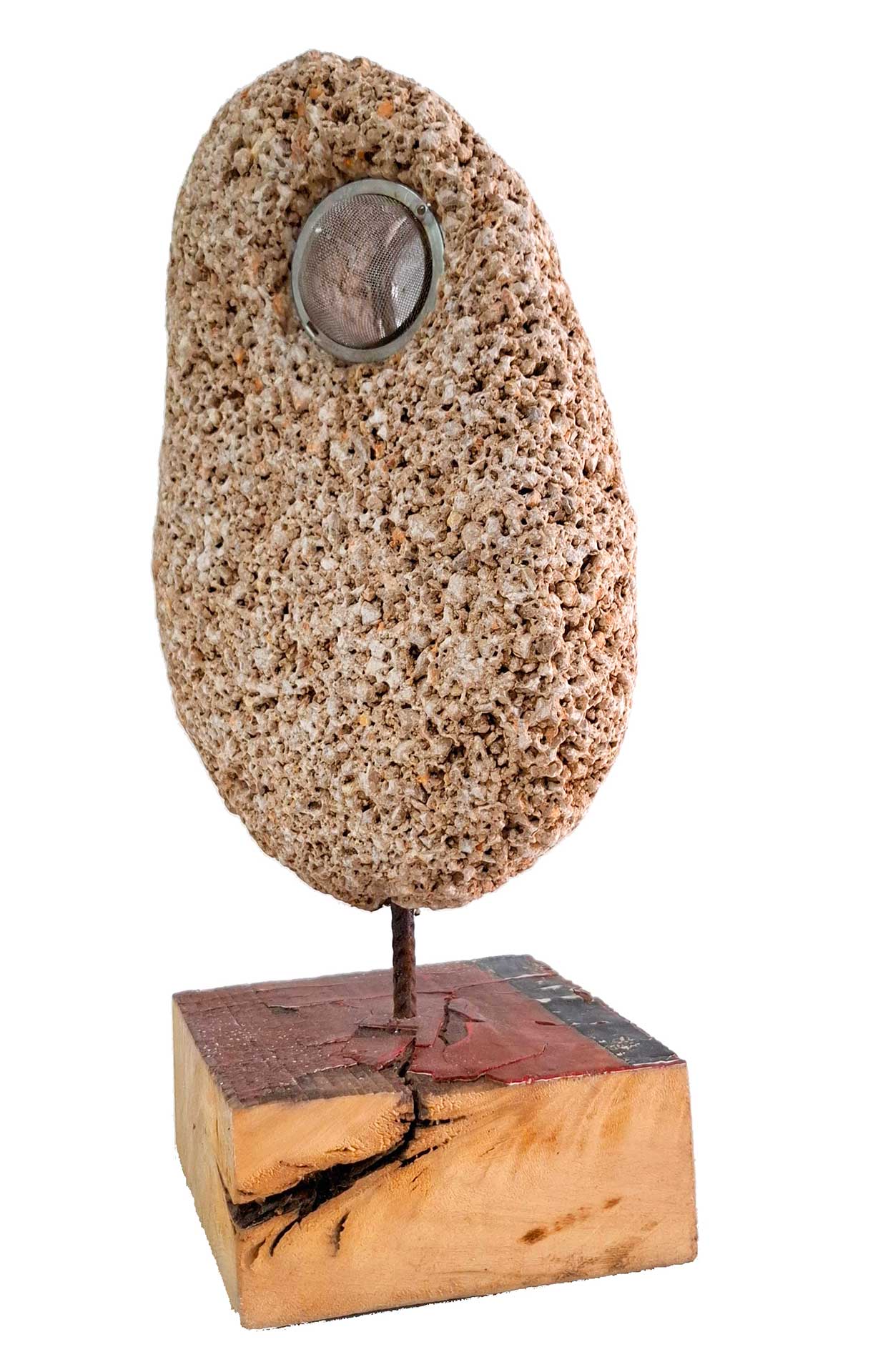
Materials: Eroded porous stone, metal sieve, iron rod and reclaimed wooden base
Dimensions: 20 × 20 × 34 cm
A perforated marine stone houses a metal sieve that functions as a single eye, giving rise to a figure of fossil-like, silent presence. Its simple form and eroded texture recall primitive idols or ancestral sculptures, while the industrial gaze of the sieve reveals the human trace inscribed within the material.

Anchored upon a worn wooden base and an oxidised rod, the piece intensifies the tension between the natural and the manufactured. Functional objects that have lost their use — a domestic utensil transformed into an organ — acquire new meaning here. Cyclops thus presents itself as a vestige of the future: a totem of the Anthropocene situated at the threshold where stone and technology can no longer be separated.

On Brancusi

Artist: José R. Martín (Jrmartin), 2025
Series: Figures of the Shoreline
Medium: Hybrid sculpture / Assemblage
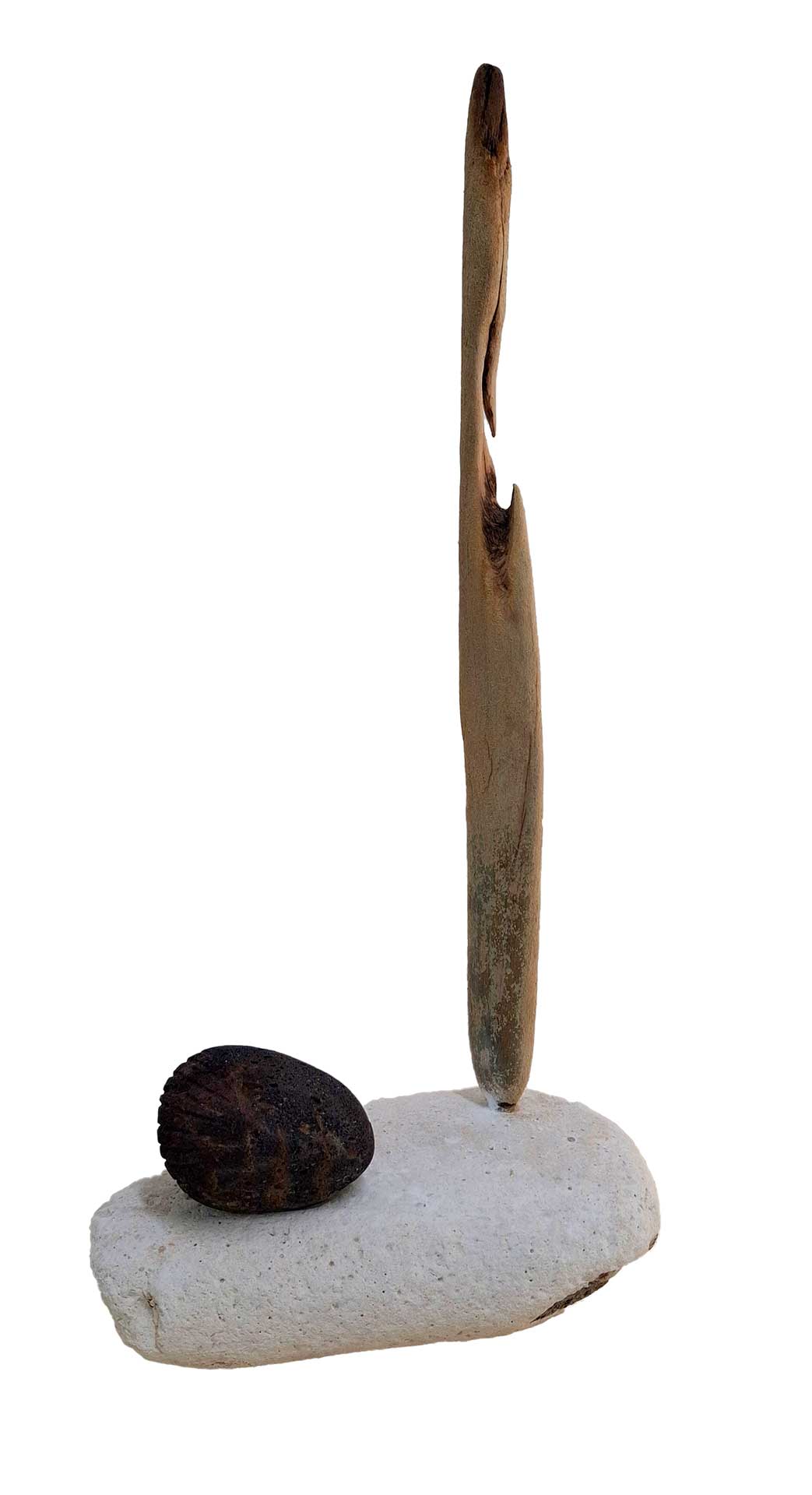
Materials: Driftwood, lightly carved volcanic stone and artificial granite stone base eroded by the sea
Dimensions: 38 × 35.5 × 62 cm
The work brings together three materials found along the coast — driftwood, volcanic stone and a base of artificial granite worn by the sea — in an assemblage of minimal gestures. The verticality of the wood and the oval stone evoke, without literal quotation, the ascetic column and the sleeping muse of Brancusi, understood here as formal memory rather than direct reference.

The intervention is deliberately restrained: to select, to join, and to respect the traces already inscribed by time and the ocean. What was once industrial and eroded becomes landscape; what was found becomes sculpture. The piece proposes a continuity between modernism and shoreline, where essential form is not imposed, but emerges through a dialogue between matter, erosion and permanence.

The Seed of the Anthropocene

Artist: José R. Martín (Jrmartin), 2025
Series: Figures of the Shoreline
Medium: Hybrid sculpture / Assemblage
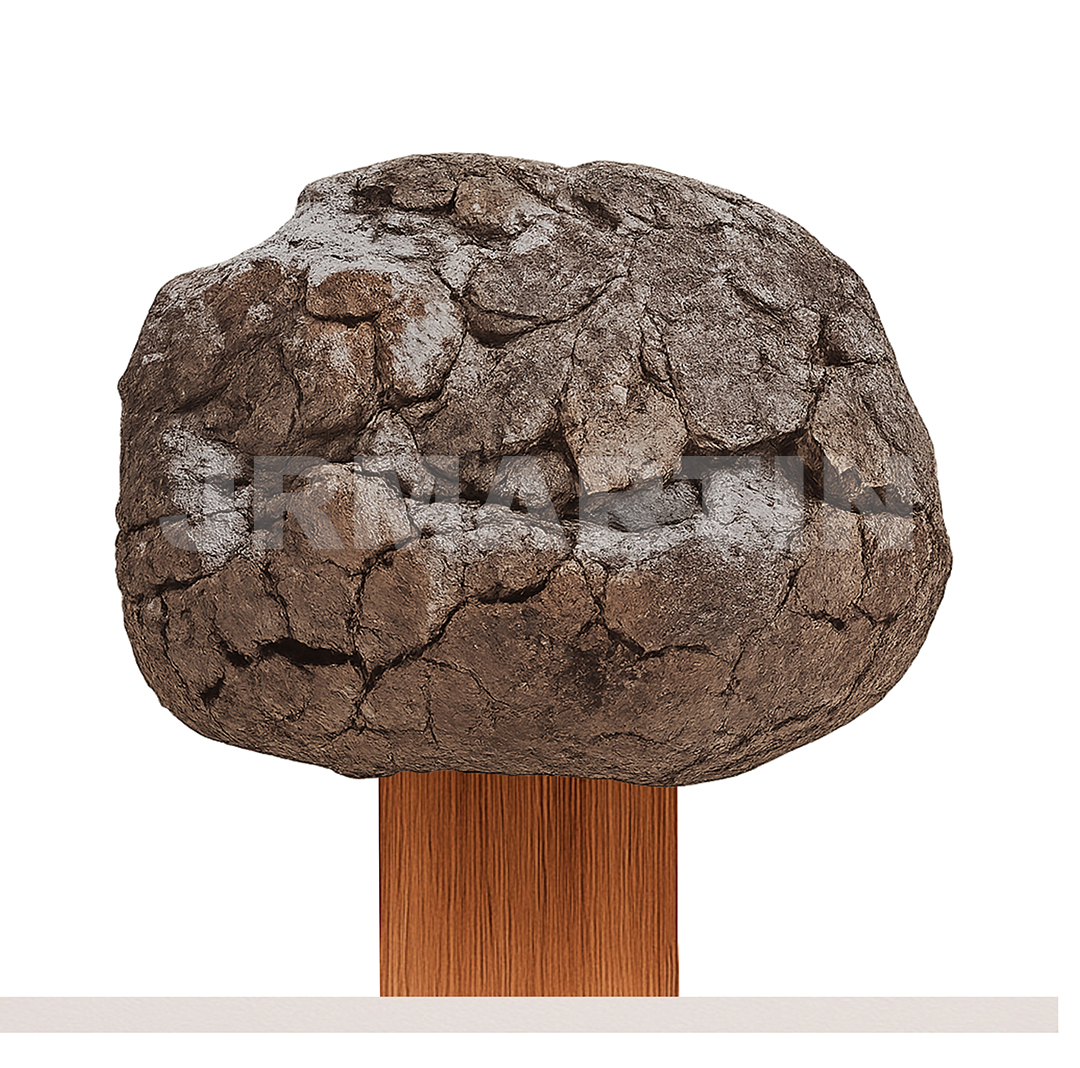
Materials: Solidified industrial pigments, synthetic particles and coastal sediment
Dimensions: 24 × 24 × 28 cm
It was not created by the artist, but by time and the sea. This piece was found half-buried in a cove on the island, formed from industrial pigments, plastic residues and sand compacted by the action of the tide. Its cracked, mineral surface evokes a meteorite, a fossil or a ritual object. Without formal intention, it nevertheless possesses undeniable sculptural force.

This fragment stands as a witness to the Anthropocene: an era in which human waste becomes integrated into geology. What we see could be described as a plastiglomerate, a new hybrid formation already studied by science. It is residue transformed into stratum — matter of the present with the appearance of the future.

Shoal of Migrants

Artist: José R. Martín (Jrmartin), 2025
Series: Figures of the Shoreline
Medium: Hybrid sculpture / Assemblage
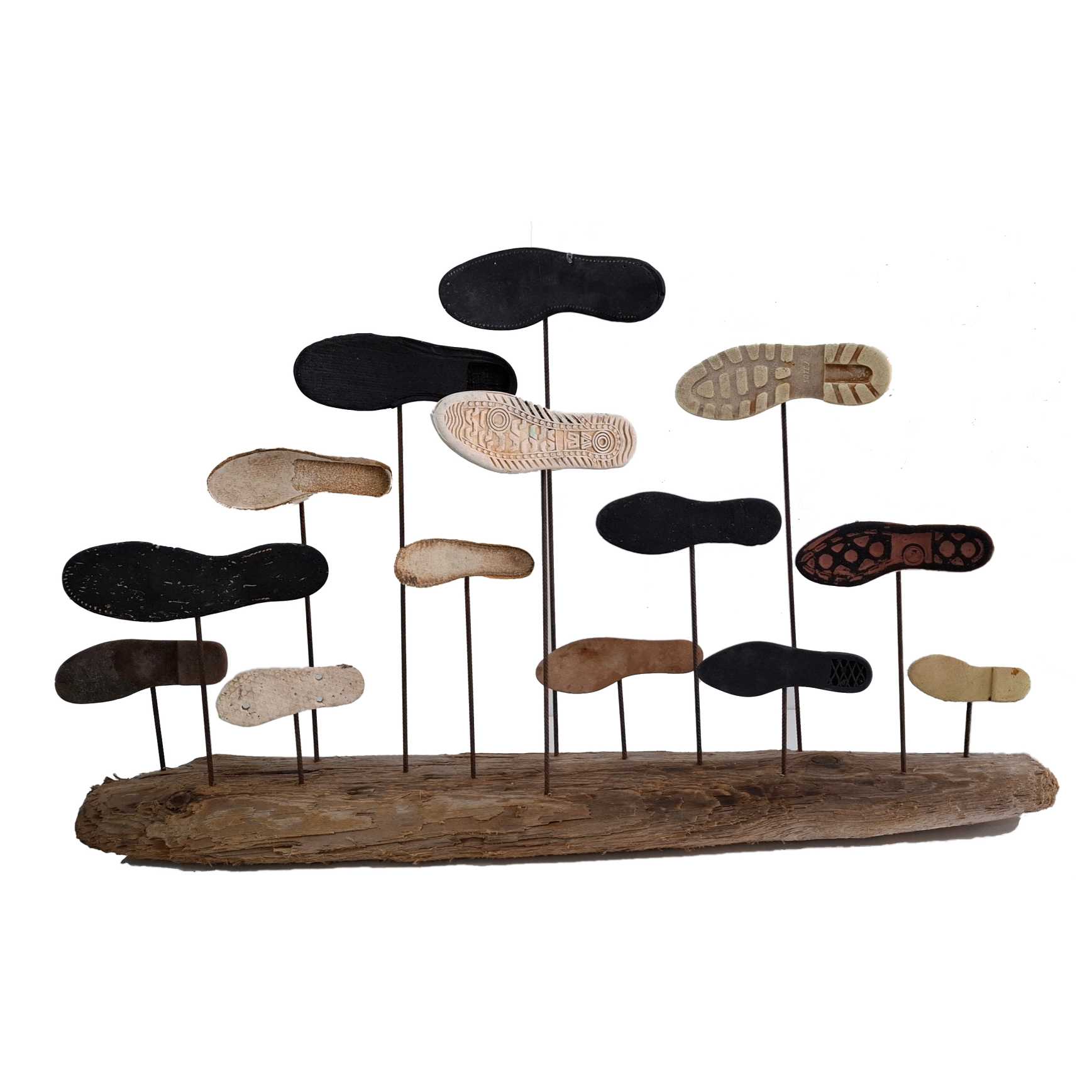
Materials: Shoe soles, driftwood and oxidised iron rods
Dimensions: 130 × 19 × 77 cm
Soles recovered from between the rocks are transformed here into a shoal of fish suspended above a stranded trunk. Each footprint, now rendered as a marine silhouette, evokes a journey: wandering fragments that crossed oceans before becoming memory.

The work fuses human waste with animal form. With irony and melancholy, it turns the individual trace into a collective creature: they no longer walk, yet they migrate. Their suspended displacement alludes to the drift of those who cross the sea out of necessity, and to the paradox of leaving a trace even when one does not arrive.

These forms belong neither to the animal nor the mineral realm. They are anticipated fossils of the Anthropocene, hybrid beings born of abandonment — a marine fiction that speaks of time, passage and the point at which the human becomes sediment.

Pelican

Artist: José R. Martín (Jrmartin), 2025
Series: Figures of the Shoreline
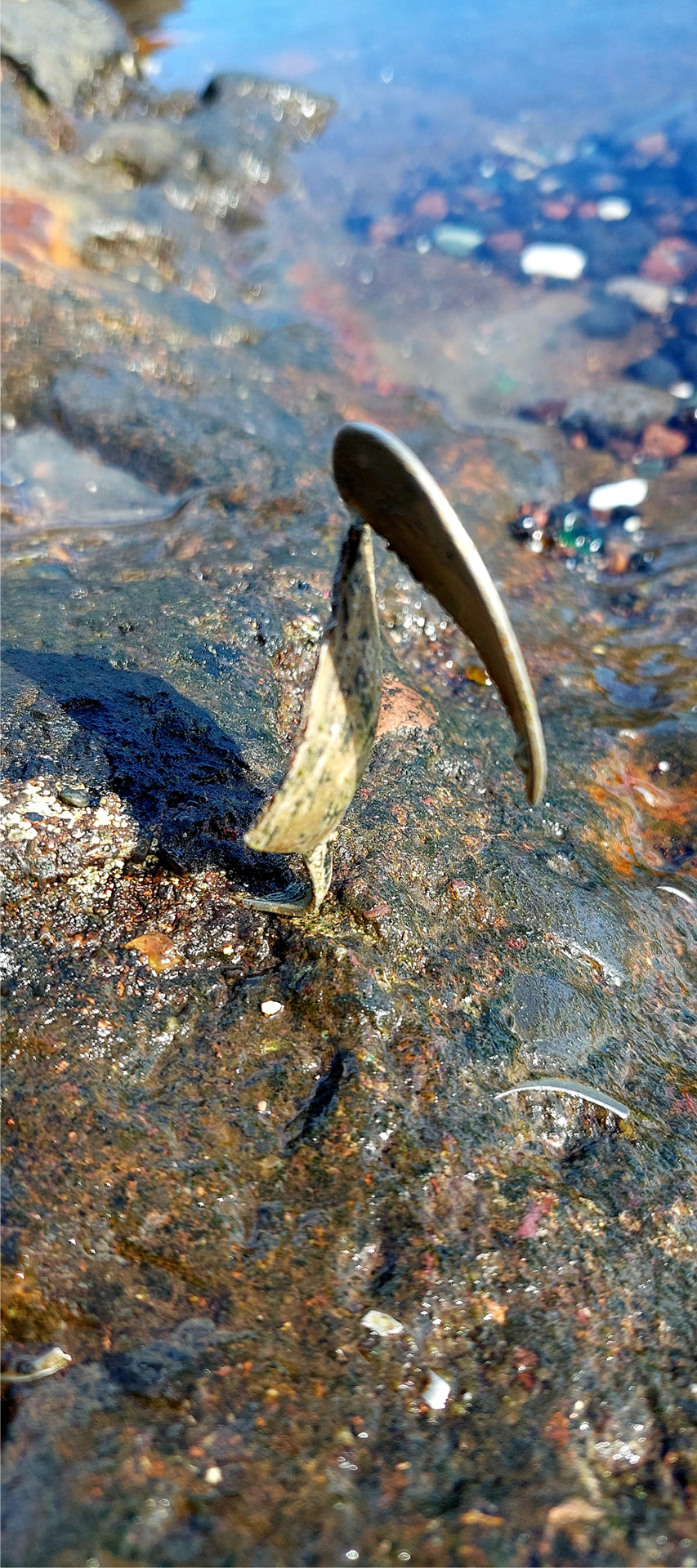
Medium: Digital photograph printed on canvas
Dimensions: 160 × 80 cm

A metal fragment, likely a discarded spoon, emerges vertically from a rock eroded by the sea. Oxidation and organic deposits have altered its form until it suggests the curved beak of a bird, granting it an almost sculptural presence. Without any intervention, the scene reveals how the gaze can discover poetic figures within waste.

Pelican situates this finding at the threshold between found object and discarded residue, capturing a moment of improbable balance in which rubbish appears to come alive. The shoreline thus becomes a space of spontaneous micromythologies, where nature and culture reflect and blur into one another.