What the tide refused to take

This section opens the trajectory of Archaeologies of the Anthropocene: Fragments of a Wounded Planet, transforming remains collected in an island cove into real objects presented as recovered findings.
Here the project’s thesis takes material form: that waste, slowly absorbed by its surroundings, becomes vestige. The objects on display stand as physical evidence of an altered planetary metabolism in which human refuse resists natural integration.


Anthropocene Findings

Here the project’s thesis takes material form: waste, slowly absorbed by its surroundings, becomes vestige. The objects I present stand as physical evidence of an altered planetary metabolism in which human refuse resists natural integration and remains as active residue of the present.

The Residue as Museum Object

In this section, rather than turning to photography, the focus shifts to the collection of real objects and their visual organisation as fragments. I present these findings as if they were museum artefacts, employing a museographic strategy that reinforces the idea of an archaeology of the present.

By displaying them in vitrines or on specific supports, I grant them the solemnity of historical fossils, establishing a dialogue between art, science and contemporary ecology. My voice appears in a series of wall statements that condense the central critique of this section:

“This is what we are when the sea returns what we have thrown away.”

From Transformation to Memory

This section represents the culmination of the project’s creative process. After collecting remains daily for several weeks in a landscape marked by marine pollution, I transform traditional sculpture into archive.

What the Tide Refused to Take confronts us with the fossil of the future: a layer of plastic waste, metals and concrete that the Earth, the oceans and the atmosphere already preserve as our signature. It is an invitation to radical observation, because everything shown here was found.

Conclusion

Taken together, What the Tide Refused to Take presents isolated words and material fragments rejected by nature which, once elevated to artworks, become a sculptural chronicle of our species.
In the same way, Layers of the Present reveals the manuscript we are writing upon the Earth, while Paintings of the Subsoil exposes its aesthetic.

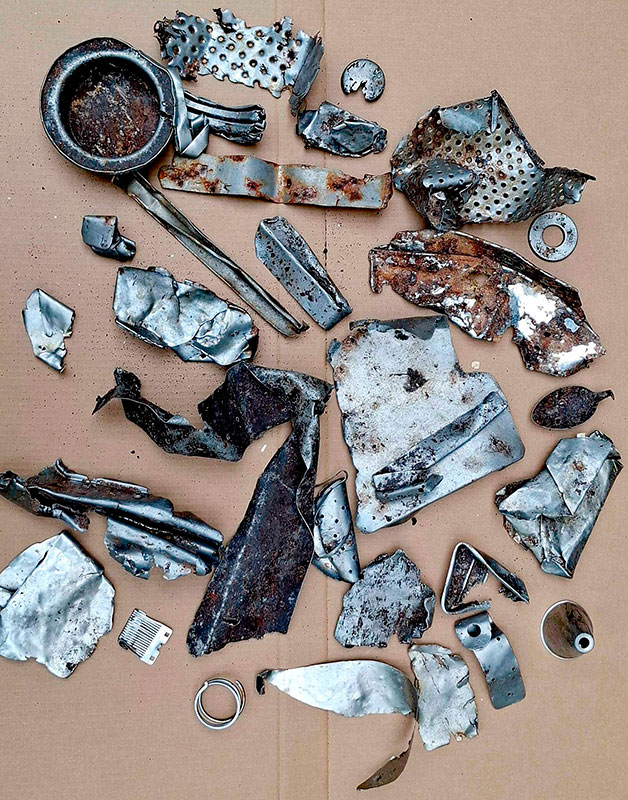
Fragments of iron and alloys return as persistent remains. As they corrode, they release oxides and ions — copper, zinc, lead — that alter the water and affect the life forms it sustains. Salt and acidification accelerate their degradation, breaking them into sharp-edged fragments that wound bodies and territories. They are enduring traces: residues the sea returns and the landscape absorbs as part of its own material fabric.

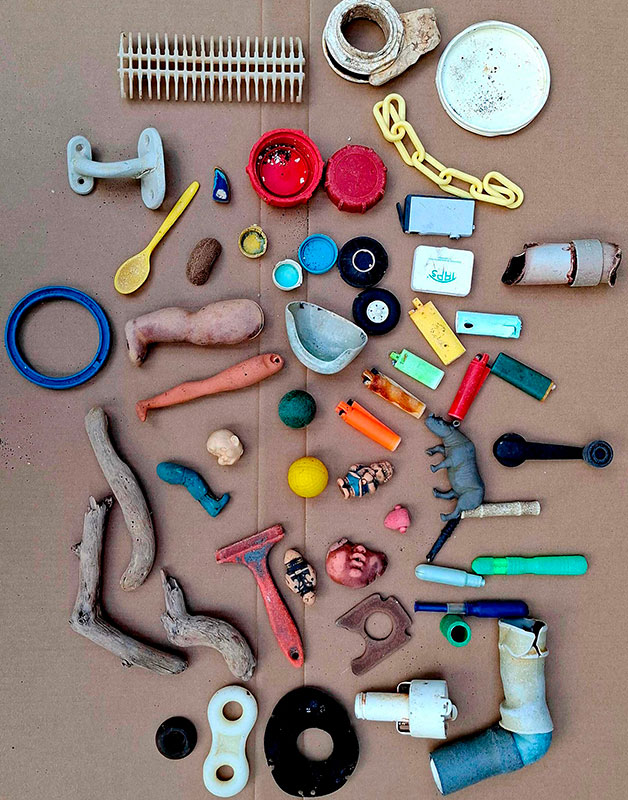
Fragments and fibres break down until they become almost invisible. Reduced to micro- and nanoplastics, they disperse, attract toxins and release substances that disrupt the bodies that ingest them. They circulate through plankton, fish and birds, pass across habitats and enter our food chain. They persist for decades: a synthetic trace of the Anthropocene that the landscape can no longer erase.

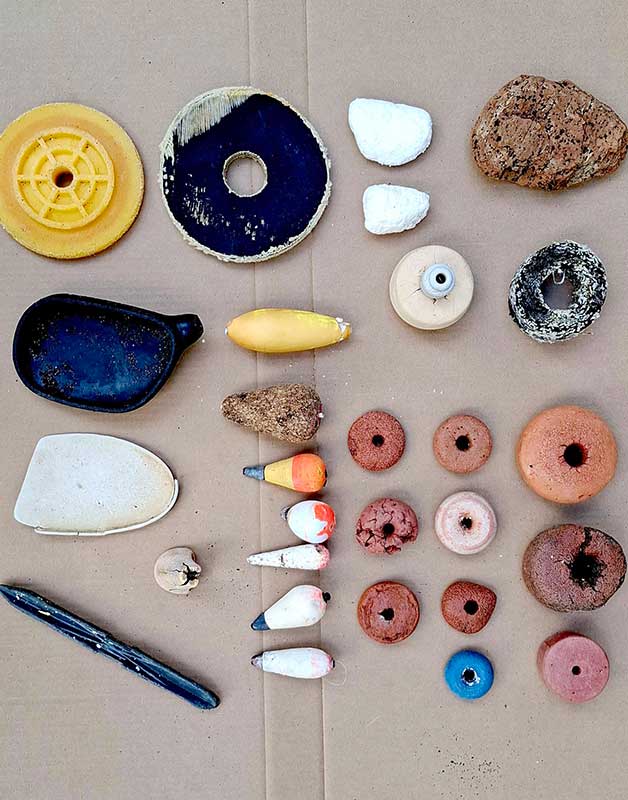
Polystyrene breaks apart into minimal, lightweight fragments carried for miles by wind and sea. Reduced to pellets and thin sheets, it becomes embedded in beaches and rocks, releasing styrene and other additives while trapping contaminants from the water. It passes through the bodies of birds and marine fauna, obstructs, intoxicates and endures. It is a persistent material, difficult to remove, which the landscape incorporates as a white scar of the Anthropocene.

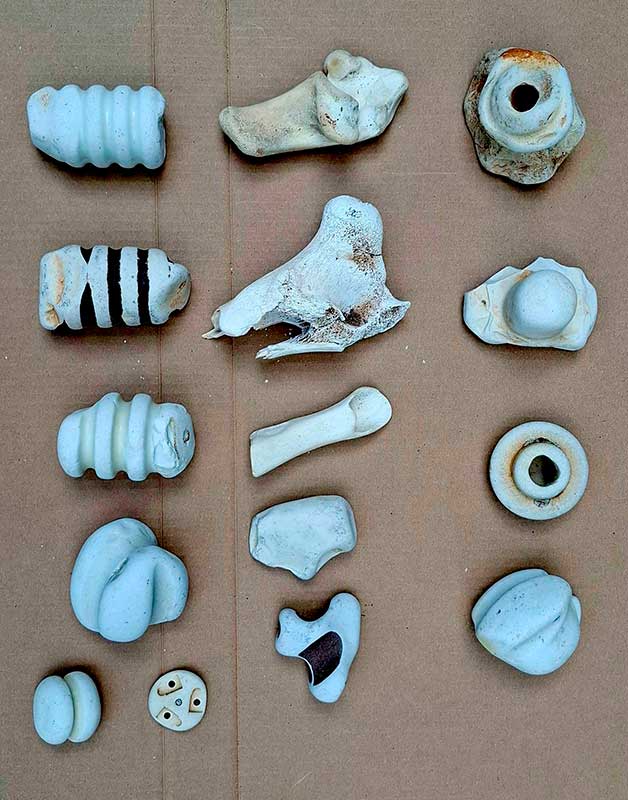
Ceramic may appear stable, yet its glazes wear away in contact with the sea. As they corrode, they release metals that settle into sediments and quietly alter the environment. Once fragmented, ceramic leaves sharp edges that wound bodies and terrain. It is a persistent residue — hard, domestic — that the landscape absorbs as a fractured memory of the Anthropocene.